
You probably shouldn’t read this post unless you’ve gone through my novella Motocross Legend, Love of My Life, that you can start reading here.
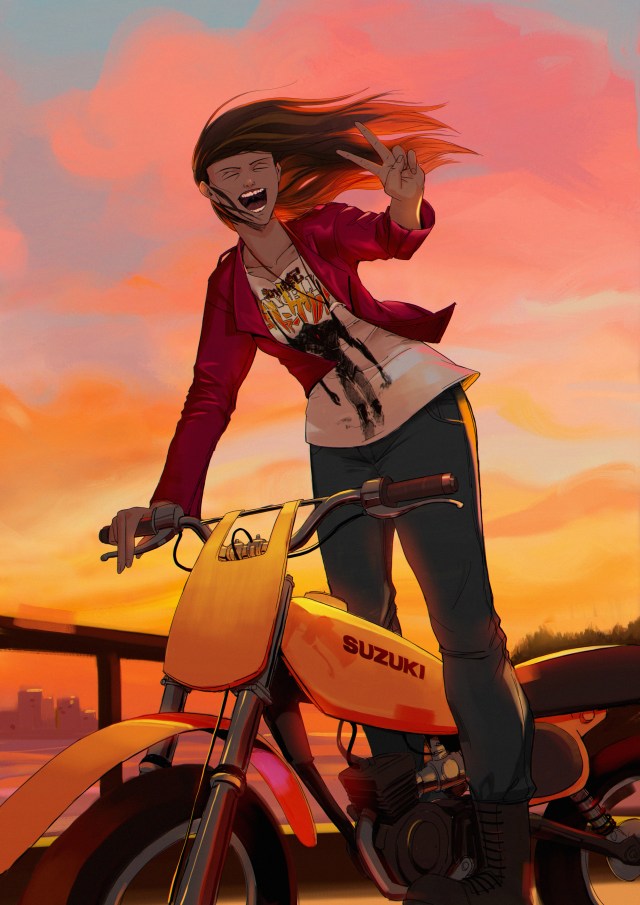
Back in January of this year (2024), I was happily writing away at the last stretch of my hella-long novel We’re Fucked, when, for no discernible reason, I chose to rummage through my rarely-touched drawers and came across an external hard drive. Hoping that it contained albums I hadn’t heard in years, I checked its contents. I discovered the album Sweet Heart Sweet Light by Spiritualized. I had recently used one of their songs for We’re Fucked, and I didn’t recall ever listening to this other album, so I put it on. As the second song, titled “Hey Jane,” played, my subconscious stirred. Vivid images kept bubbling up, far stronger than usual daydreams. One image in particular lodged itself in my brain: a brown-eyed teenage girl leaning on her motorbike’s handlebars at night, smiling warmly at the person who was approaching her. I immediately recognized the strength of this feeling. My subconscious had gifted me such epiphany-level impressions only a few times throughout my life. If I’m lucky, it will do so a few more times in the future. I had been granted a story seed.
The rest of that day, and the following few, were taken over by the obscure workings of my subconscious as it wove together, almost entirely by itself, the tale of this stranger: who she was, why she seemed so comfortable on a bike, who was she smiling at so warmly, etc. I don’t recall how the narrative evolved into one about an aspiring motocross rider with a recklessness streak bordering on tragic flaw. However, it soon became clear that this tale wouldn’t be about love, but grief.
I suppose I have to mention, as I often do, that I’m quite fucked in the head. Was born with so-called high-functioning autism, and either developed after, or got as a side-effect of the abnormal neurological development, some level of OCD that fucks me up with intrusive thoughts, obsessions on top of autism’s own obsessions, and such. Like many on the fringes of typical human behavior, I’m fascinated by outsiders and edge experiences: UFOs, hidden history, weird artifacts, long-extinct animals… Regarding humans, which I rarely care about, I was drawn to the serial-killing kind. While some people, mainly certain types of women, obsess over such monsters and view them as heroes, even attempt to date them, I obsessed over their victims. I wanted to learn everything about who they were before they crossed paths with the man who ended up murdering them. I dreamed about the killings, and imagined myself intervening in those troublesome encounters to save the victims. Even when I didn’t dream about such events, I daydreamed about them. I wrote a couple of stories, of the ones I remember clearly now, of a jaded time-traveler that returned solely to prevent such killings.
With the widespread use of the internet, I came across blogs belonging to relatives of murdered people. One of them that impacted me significantly belonged to the mother of a poor teenager who was killed returning from a concert back in 2008 or so. She got in the car of the wrong person, who raped and murdered her. The mother never got over it (I certainly wouldn’t be able to), and her posts were a window into unending grief, the kind that shoves the person away from the mass of humanity into the fringes.
I know quite a bit about standing in the fringes of humanity. I’m 52% disabled according to the Spanish goverment. During my twenties, that were mainly wasted in long stints as a hikikomori (the pee-in-bottles, befriend-spiders kind), I visited centers for extremely disabled people, and got to interact with the types of human beings you simply do not come across in your daily life: otherwise normal-looking women who were unable to string a sentence together, very intellectually challenged people who casually walked over to groups and ripped loud farts nonchalantly, people so hideous it hurt to look at them, the twitching-and-shouting-insults kinds, the dangerously deluded, some who most weeks presented fresh tales about shitting themselves while “straight-jacketed,” etc. Parents of low-functioning children would often look on with horror at institutionalized low-functioning autistic adults as they were herded around while they twitched and groaned. “It this all I can hope for?” Many human wrecks out there are kept out of view from the public at large lest they disturb the delusion of a just and ordered world.
Whatever neurological configuration drives people to seek out face-to-face interactions has never quite worked for me: human beings in general feel like wild animals, and not the cuddly kind. I’m always wary of people and keep them at arm’s length, partly due to the anxiety I feel in social situations, partly because I lack the innate ability to read their intentions. Over the years, I’ve been tricked and manipulated. I’ve had people tell me, “Why do you keep talking so casually with those individuals? They clearly hate you,” and I didn’t have a clue. In general, people bring more trouble than they’re worth, and my experience with intimate relationships convinced me that such connections lead to mutual pain. Therefore, I’m bound to a life of solitude.
Anyway, what I meant to convey is that my subconscious compelled me to create a tale about someone dealing with unending grief, the kind that isolates him from the rest of humanity. Had I loved someone like Izar Lizarraga, I would have ended up like the narrator, if I hadn’t killed myself to begin with. This is the extent of my justification for why I write what I do. In truth, I simply write to fulfill the demands of my subconscious, hoping to satisfy it. Rational thought plays no part. In fact, I’m extremely suspicious of what’s generally considered intelligence.
I didn’t choose consciously the details of Izar as a character, as well as her relationship with the narrator, but my subconscious was clearly inspired in many cases by my past relationships. The closest in spirit to Izar was a sixteen-year-old basketball player named Leire whom I met online (she was a friend of a dude I used to hang out with), and who later on pursued me romantically. She was reckless, perhaps a bit touched in the head, given that she was interested in a lanky, pimply, clearly deranged teenage me. Anyway, we lay under the stars and had a romantic conversation full of idealism, the details of which I have completely forgotten. Some other day, she invited me to her home, where we made out. We ended up cutting that date short because her parents returned from a trip early.
After that day, I ghosted her. Why would I abandon such a sweet girl without a word? Because right then I understood something: that relationship would end in ruins, like they all would, and liking her as much as I did, like I never had before and never have since, meant that the end of that relationship would obliterate me. Even now, as a thirty-nine-year-old man, I consider that ending it before it truly began was the right choice, given my inability to sustain intimate relationships. However, I regret ghosting her. I regret having lost the opportunity to know her better. Due to my prosopagnosia (an autism-related inability to retain and process people’s faces), I don’t know if I ever saw her again. I can’t even stalk her online, because I forgot her last name. She didn’t deserve to be treated that way. Wherever life took you, Leire, I hope you’re happy.
Fellow autist and writer Patricia Highsmith famously told of a woman she briefly met while working as a toy saleswoman: a sophisticated, mommy-type blond to whom Patricia sold a doll, and with whom Patricia fell in love at first sight. They never saw each other again, but Pat, in her usual manner (she’s the author of Strangers on a Train, The Talented Mr. Ripley series, etc.), proceeded to stalk the woman’s home to get some modicum of understanding of who she was. In later years, Patricia referred to that woman as the love of her life. In a similar sense, Leire is very much the love of my life: the most fascinating girl I have ever met, with whom I would have enjoyed lovely adventures if I weren’t such a piece of rotten shit.
Deeper than that, and I suspect this revelation may disappoint some, Izar Lizarraga of this story’s fame is partly my subconscious itself. Maybe other people can identify with their subconscious as if it were an integrated part of themselves, but for me it’s this mysterious, intelligent being who presents me strange visions, who urges me to work on stuff that pleases her, and to whom I can show some part of a work of art I’m working on, from writing to music, and get a wordless response of the kind “this sucks” or “I love it.”
This subconscious of mine, a creature that feels female, is someone I’d rather interact with instead of any flesh-and-bone person, and who has guided me along in many adventures that I wouldn’t have experienced otherwise. I have never felt truly alone because my subconscious has always been there to bring me interesting dreams (I wouldn’t say beautiful, because plenty of them were horrifying). Back when I thought I could sustain normal human relationships, I regularly ached to return to my subconscious’ side, a more interesting and reliable person than pretty much anybody. I adore you, subconscious. I wish I could make love to you. If you had a butt, I’m sure it would be real nice.
I think that’s all the context I wanted to add to this story. Barely anybody read it, but those of you who followed the tale of Izar Lizarraga and the man she ruined, I hope you got something valuable out of it. And if you didn’t, hey, the one I intended to satisfy is pleased.
 The Domains of the Emperor Owl