
Four stars.
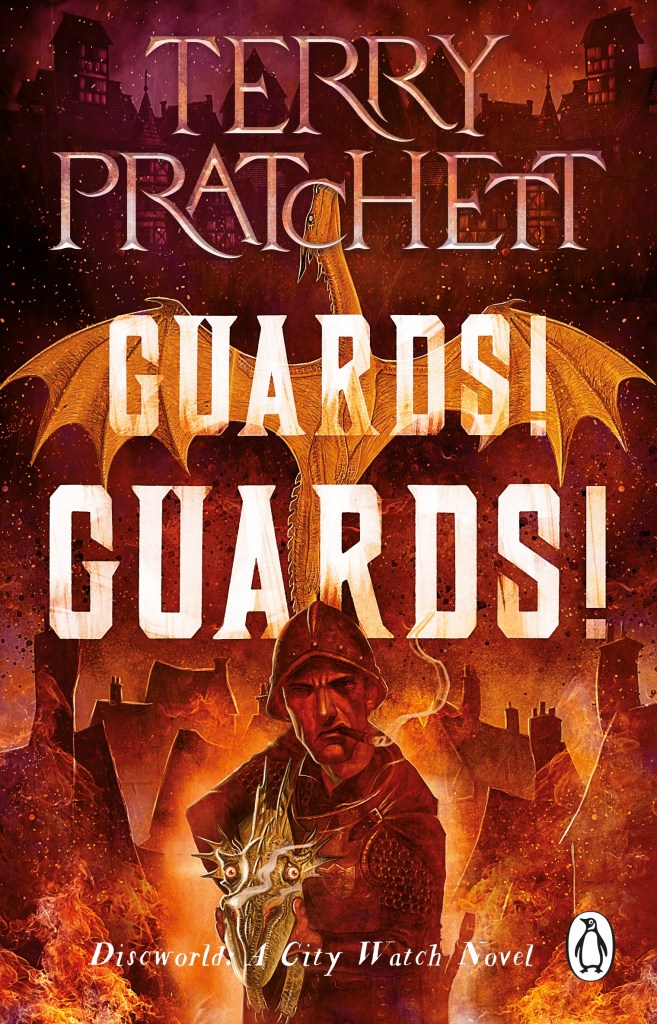
This is the first book in the City Watch series set in Pratchett’s Discworld universe, a flat Earth carried on top of four elephants who are in turn carried on top of a Giant Star Turtle named Great A’Tuin.
We first meet our memorable protagonist, Sam Vimes, the captain of Ankh-Morpork’s city watch, as he stumbles drunk after he and his colleagues buried a fellow guard and friend. He ends up lying in a gutter, delirious. Our middle-aged man leads the watch in a city where theft and murder have been regulated; the leaders of the thieves’ and assassins’ guilds sit at the Council, and they are to remain unbothered as long as they don’t exceed their allowed amount of thefts and murders per month. The city watch remains as a remnant of the old days, to give the populace the impression that someone’s keeping the peace in a traditional way, but the very few guards that remain are powerless. When there’s some perp to apprehend, the watch are to run in pursuit but not fast enough, lest they end up having to go through the trouble of arresting anybody.
Trouble starts when some cultist breaks into the library at the Unseen University of Magic and steals a book on how to summon dragons, to the dismay of the librarian, who is, for reasons, an orangutan. This cultist has gathered a bunch of disgruntled citizens and wants to use them to steal magical artifacts, which will allow him to summon one of the dragons of old from their plane of existence. As chaos ensues, this group will introduce a supposed heir to the old kingdom of Ankh, a hero capable of defeating the dragon. Once the pantomime plays out and the current leader is deposed, a new king will rule the city of a hundred thousand souls (and about ten times that amount of bodies, as Pratchett put it). However, that king would be a figurehead; the cultist’s leader intends to rule from the shadows.
Meanwhile, the city watch encounters a disturbance of its own: some dwarf from another county has volunteered to join the watch, believing it to be a noble occupation. In reality, this dwarf is a six-foot-something human who was adopted by a dwarven colony and raised as such, until his size as well as his attempts to court an underage, sixty-year-old dwarven girl became too uncomfortable. This honorary dwarf is an earnest, literal-minded fellow who illuminates the miserable state of the current city watch. Apart from Vimes we have Sergeant Colon, a load of pink flesh stuffed into an armor (I picture him as a short, non-horrifying version of Judge Holden from McCarthy’s Blood Meridian), as well as Corporal Nobby, who’s the lowest common denominator of the grimy city he inhabits, a misshapen rat of a man who’s likely to spend his time on the clock looting some passed-out or dead citizen’s valuables.

This group of losers ends up tangled against their will in the cult’s plot; one of the times they summon the dragon, it incinerates a bunch of criminals who were stalking the drunken guardsmen, that had taken a wrong turn into the nastier area of the city. Vimes, who as the author put it was born two drinks short, naturally more sober than anybody else, refuses to allow anybody but himself to burn this hole of a city. In the process they’ll have to deal with the simian librarian, the local nobility, the calculating Patrician, and swamp dragons, apart from an otherworldly, apparently unstoppable dragon who isn’t too happy about having been dragged from its slumber and being controlled by a pitiful human.
What this review doesn’t capture is the author’s humor. As some reviewer put it, he was likely the funniest satirist of the 20th century. He wasn’t just funny, but hugely insightful. His need to create humor seemed to stem from his grim outlook on the world and humanity. Captain Vimes represents the faint drive to do the right thing against a world where evil is organized and has far better plans about how to keep everything running. Neil Gaiman, who dealt with Pratchett during a book or couple of books they wrote together, has mentioned plenty of times that Pratchett had a significant temper. I suppose he was constantly disappointed by a reality that couldn’t match the fantasies he easily pictured in his mind.
Apart from his humor, Pratchett was a master at coming up with unusual metaphors and analogies that somehow captured precisely what needed to be known about the subject, without having to go into particular details.
My only issues with this book, and with Pratchett’s writing in general, is that he uses an expository narrator (I despise exposition on principle), that I would have edited out some paragraphs here and there, and that for my taste he overuses some motifs, like the notion that if there’s a million-to-one chance to achieve something, it has to work, because the gods enjoy playing those kinds of games.
The Discworld books enrich each other; some characters, like the Patrician or the Librarian, not only appear but play major roles in distinct series, so at times you may get the feeling that you would have caught on to significant subtext if only you had read like four or five other books. However, the City Watch series is, as far as I remember, quite self-contained even though recurrent characters from the Discworld universe take part in it. This is also a terrible universe to follow chronologically; Pratchett was very young in all respects when he started writing (got his first story published at thirteen years old). A couple of book sellers pushed to me Pratchett’s The Colour of Magic, the first book chronologically, which, as far as I remember, was mostly an unsophisticated parody, and not representative of the many books to come.
Back when I was a miserable teen, Pratchett’s works were among the few comforts in my nightmarish existence, along with manga, video games, and masturbation. I doubt I caught at the time most of what was going on in the Discworld books; lots of moving parts. Years later, once I was forced to pretend I was an adult, mainly because my body grew old, I gave up on Pratchett’s works along with every other memory of those years, but giving up on the Discworld was a mistake.
I believe you find life such a problem because you think there are the good people and the bad people. You’re wrong, of course. There are, always and only, the bad people, but some of them are on opposite sides. A great rolling sea of evil. Shallower in some places, of course, but deeper, oh, so much deeper in others. But people like you put together little rafts of rules and vaguely good intentions and say, this is the opposite, this will triumph in the end.
 The Domains of the Emperor Owl
Pingback: Review: Men at Arms, by Terry Pratchett – The Domains of the Emperor Owl
Pingback: Review: Feet of Clay, by Terry Pratchett – The Domains of the Emperor Owl
Pingback: Review: Jingo, by Terry Pratchett – The Domains of the Emperor Owl