

We can speak therefore we lie, we have bodies therefore we hurt others, we have eyes therefore we can be seen by other people. It’s because we have forms that we can worry over a few millimeters-large pimple, get irritated over a few centimeters-large deviation in face or body, panic over the loss of a single front tooth… Eyes are drawn to other eyes a few millimeters too large, eyes peer away from noses a few millimeters too large, eyes are stolen by women a few centimeters thin, and a man a few centimeters too short can never find eyes to look upon him. Without forms, humans cannot suffer.
Let me get this out of the way: Homunculus is a masterpiece. I first read it a few years ago, but it lingered in my subconscious to the extent that I felt the need to reread the whole series, something I rarely do. It connects with my personal issues and artistic aspirations to such an extent that it’s likely my second favorite manga series, after Asano’s Oyasumi Punpun.
We meet the memorable protagonist of this story as he sleeps curled up like a baby in his car, which is parked between a high-rise building and a homeless camp. Truly, the protagonist is stuck in the middle: not anymore the person he grew up as, nor the fake persona he adopted to triumph in a world full of deceit. Unable to tell the truth even to himself, he lies compulsively to the homeless that tolerate him, mainly because he brings booze.
One day, shortly after he realizes that he’s too broke to afford gas, a weird guy, half-rockstar half-crossdresser, approaches his car and offers him a considerable amount of money. In exchange, the protagonist will test the benefits of trepanation, which, according to Wikipedia, is a surgical intervention in which a hole is drilled or scraped into the human skull. The shady guy claims that he wants to disprove the supposed sixth sense that the subjects of such an operation are said to develop.
The protagonist figures that he may as well get a hole drilled into his skull. A few days later, as long as he closes his right eye, he witnesses a different world.
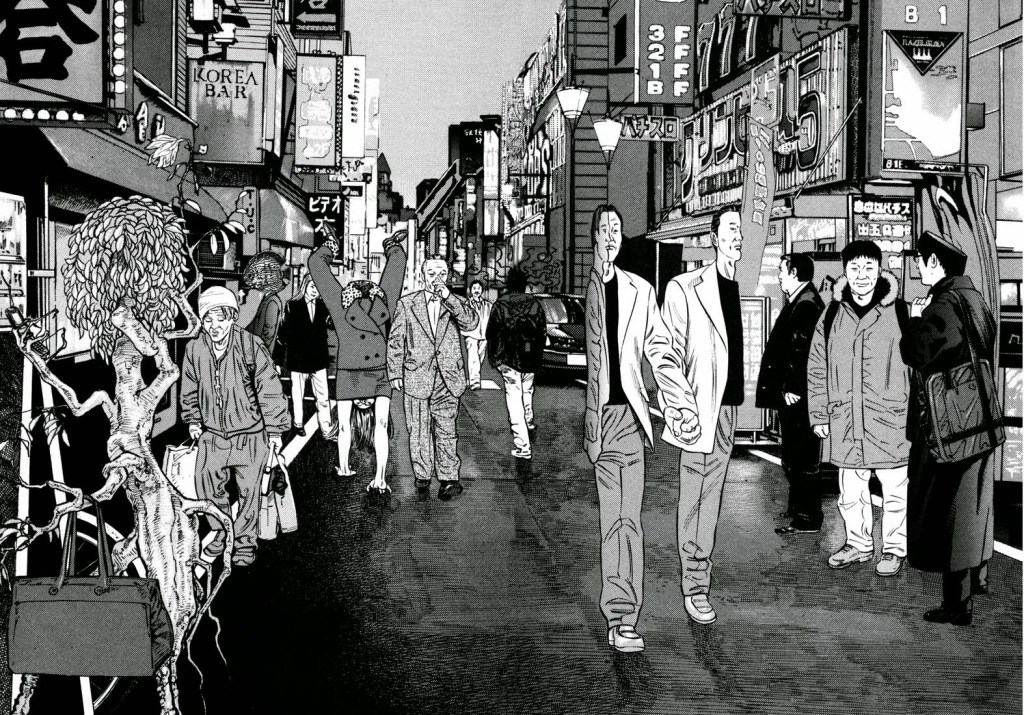
About half of the Japanese population strut around like bizarre monsters. After a chilling encounter with a Yakuza boss who looks like a boy trapped inside a robot, the protagonist starts suspecting that he’s witnessing the incarnations of psychological distortions. The mad doctor slash rockstar intends to take advantage of our protagonist’s uncanny powers, first to help the psychiatric industry. Once he gets bored of that, he intends to exploit his test subject’s sixth sense to seduce an attractive high schooler who sells her panties, and who seems to be made of sand.
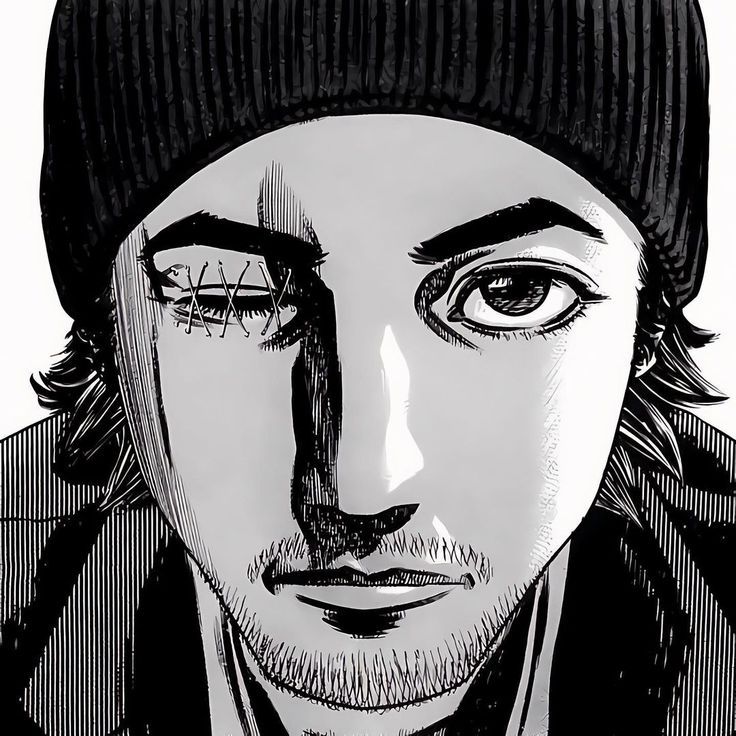
What follows is a disturbing ride in which our protagonist, as he progressively loses contact with reality, recalls little by little who he used to be, and who mattered from his former life, before he abandoned it to embrace the lies of external beauty and money to the extent that he became disconnected from his senses.

I don’t remember any other manga series that has impressed me this much with the extent of its creativity, particularly involving the shifting forms of the so-called homunculi that the protagonist faces. It even surpasses Asano’s Oyasumi Punpun in that regard. It’s also bold and fearless, hard to recommend except to other fucked-up individuals. You should probably steer away from this story if the sight of a guy slurping his own semen would horrify you.
The series isn’t perfect: one of the most memorable secondary characters, that occupies a whole chunk early on, disappears never to be seen again, and the discussions between our protagonist and the rockstar dude retread the same old grounds regarding whether the homunculi are hallucinations or represent real phenomena, long after the rockstar dude should have been convinced.
On a personal note, I was stunned with the parallels between this manga series and the novel I have been working on for the last two years. In both stories, their protagonist can see certain people as monsters whose forms are related to psychological distortions. In this story, the protagonist has forgotten his old face, mainly because it was hideous. In my story, the protagonist refuses to look at her face, because she considers it hideous (along with her entire self). Elements of body and gender dysmorphia are present in both stories; regarding my own novel, partly due to me having been born with, or developed early on, a pituitary tumor that screwed with my hormones, making me able to lactate. To whatever extent the hormonal imbalance fucked my brain up must be related to how comfortable I feel writing female characters, even though I don’t want to be a woman in real life (what a hideous sight that would be). Regarding the similarities between both stories, I can’t tell how much I borrowed from this one, because such things don’t happen consciously. I think it’s more likely that the author and I are similarly troubled.
Too bad that Yamamoto hasn’t created any other series that even comes close. The other one of his that most sites recommend, Ichi the Killer, is extremely amateurish in comparison. It’s hard to get ahold of his remaining works. Perhaps he poured himself into Homunculus to the extent that there wasn’t much else left to say, similar to what happened to Asano and his Oyasumi Punpun.
At some point of this story, the protagonist embraces the homunculi not as reality, not as hallucinations, but as the truth. Those bizarre forms can be felt, from an artist’s perspective, particularly a writer’s, as the equivalents of the little monsters that populate our stories, all incarnations of our own personal truths that are otherwise almost impossible to see.
Anyway, if you enjoy fucked-up, extremely original tales, do yourself a favor and read this series.

 The Domains of the Emperor Owl