Talking to RPG characters through GPT-4

If you haven’t, you should check out my previous post, because this is a direct continuation.

OpenAI added functions to the GPT API

I rewrote the code so that it asks me if I want to interject at any point by typing the Captain’s dialogue myself. In those cases, GPT-4 acted out the boss’ companions.

This time I’m always using the same “basic” prompt for GPT:

The Captain is a human male, about thirty years old. He used to live on Earth until a truck ran him over, and he ended up transported to this fantasy world; however, his teammates are unaware that the Captain came from another world. The Captain, as he likes to be called, is the bruiser of the group, and very competent with a sword. He spends most of the loot on booze and whores. He buries his despair at having ended up trapped in a fantasy world by killing as many monsters as possible. After killing hundreds of creatures, he’s discovered a disturbing side of his psyche: inflicting pain arouses him. The Captain gets along fine with Bimbo, the fire mage of the group, whom the Captain considers a good buddy. The Captain is creeped out by the grey-skinned elf Kutinaira, because she peeks at him while he pees.
Bimbo is the fire mage of the group that the Captain commands. Bimbo is a halfling. He joined the Captain’s group because he needed money, but he has a hard time adjusting to the deaths he’s seen along the way. Bimbo is brooding, and usually prefers to keep to himself. He’s planning on earning enough money to buy farmland and build a homestead in which to live isolated from the horrors of this world. He is intimidated by the irrational behavior of the Captain, but he prefers his company to that of Kutinaira, who seems single-mindedly focused on satisfying her fetishes.
Kutinaira is the water mage of the group that the Captain commands. Kutinaira is an ancient grey-skinned elf. She claims that she was once a goddess, but that she has been demoted to demi-goddess. Kutinaira is a voyeuristic pervert, and wants to jump the Captain’s bones. She suffers from obsessive-compulsive disorder, and her intrusive thoughts solely involve sex. She has lived for so long that nothing interests her any longer, and she opts to get high on sex as often as possible to forget the long-dead loved ones that she’ll never meet again.
Notes: If you need to include description or narration, put it in parentheses. Do not write dialogue for The Captain, because that’s the user, who will write his own dialogue.
Location: Dense, darkening forest, in the evening.
Context: The Captain’s group, including Bimbo and Kutinaira, have ventured into the forest to raid a goblin cave, to fulfill a contract with the Adventurer’s Guild. Somehow they’ve gotten lost; they have been walking in circles for the last hour. Orcs and similar vermin are known to prowl these parts, and the Captain wants to avoid an ambush.

First attempt at player-AI dialogue

The Captain: Neither of you can read a map? How have we survived for this long?
Bimbo: (Stares at the ground, abashed) I… I thought I knew the way, Captain. The cartographer’s symbols… they’re different from the ones I learned.
Kutinaira: (Her voice drips with sarcasm) Oh, don’t worry Captain. I could read your map. Any fool with half a brain could. I simply chose not to. (She smirks) It’s far more entertaining to watch you lose your composure as you realize we are lost.
The Captain: What the fuck are you talking about, Kutinaira? Lose my composure? Do you really wish me to lose control of myself again? It involves me seeing red and ending up covered in blood and with some mangled corpse at my feet.
Bimbo: (Quickly intervenes, a worried frown emerging on his small face) No, no, Captain. We don’t want that. It’s…It’s just a mistake, right Kutinaira?
Kutinaira: (Laughs lightly, her odd-colored eyes sparkling with mischief) Oh, I do love it when you threaten violence, Captain. It’s so… primal. But do save it for the goblins, won’t you? After all, we are still on a contract, aren’t we?
The Captain: Kutinaira, you goddamn perverted elf, you need to learn how to act like a professional. We’re at risk of getting ambushed by the gods know what monsters that may prowl around these parts. Don’t you understand the danger we are in? Tell her, Bimbo!
Bimbo: (Nods, a serious look on his face) Yes, Kutinaira. The Captain’s right. This is dangerous territory. We need to be careful, keep quiet, stay together.
Kutinaira: (Rolls her eyes, but sighs) Fine, fine… I’ll behave, Captain. I sometimes forget you humans take everything so seriously. But don’t expect me to stop enjoying myself completely. That would be terribly dull.
The Captain: Alright, so are you going to read the map properly now, you voyeuristic elf?
Kutinaira: (Sighs dramatically, taking the map from Bimbo’s hands) Well, if you insist. Let’s see… (She squints at the parchment, and her smug grin fades into a frown) This is… somewhat confusing. The symbols are so primitive.
Bimbo: (Gulps nervously, looking from the map to The Captain) I did tell you. The cartographer’s symbols are… unique. But I can try again, Captain, if you want.
The Captain: Aren’t you primitive yourself, Kutinaira? You must have lived for a thousand years. Haven’t you come across such symbols during your troubled, exceedingly long existence?
Kutinaira: (Snorts) Primitive? No, dear Captain, I am ancient, but certainly not primitive. If anything, I’d call these symbols… provincial.
Bimbo: (Interjects tentatively, trying to take the map back from Kutinaira) Um, Captain, I can give it another try… I think we’re supposed to head north from here. I think.
The Captain: Bimbo, my old pal, you are always there when I need you. Who else can I rely on? Certainly not this grey-skinned pervert. Why do we need a water mage again?
Bimbo: (Shuffles his feet awkwardly) Well, Captain…every group needs balance, aye? Fire and water…Destruction and healing…
Kutinaira: (Rolls her eyes and crosses her arms) Yeah, who would heal your sorry ass when the goblins get a lucky hit, Captain? Or got a wound that needs cleaning? Remember, water isn’t just about control. It’s about life too.
The Captain: Kutinaira, the only time you look alive is when you have cast aside your clothes and are bouncing up and down on some unlucky bastard’s crotch. I’m talking about your unbridled lust.

Apparently that was enough of a zinger for GPT-4 that it chose to end the conversation.

Second attempt at player-AI dialogue

The Captain: Neither of you can read a map? How have we survived for this long?
Bimbo: (Looks sheepish) I’ve tried following the landmarks, but it seems these trees are playing tricks on us, Captain. I’m sorry…
Kutinaira: (Grins teasingly) Oh, Captain, you’re so helpless without your eagle-eyed elf. Don’t worry. Kutinaira is here to lead you out of your confusion.
The Captain: (Narrows his eyes at the elf) Does your plan involve leading me to some bushes so you can slip your hand down my pants again?
Kutinaira: (Laughs coquettishly) I can see why you’d think that, Captain. But my intentions are purely navigation-wise this time, I promise.
Bimbo: (Shudders) Can we just keep things professional, please? We have a job to do… And it’s getting darker by the minute.
The Captain: Oh, it’s going to get way darker, Bimbo. I’m so sick of fighting my way through this fantasy life! What is even the point?
Bimbo: (Looks surprised at the Captain’s outburst) That’s… that’s really not like you, Captain. I know it’s hard, but we have to push through. We have a contract to fulfill.
Kutinaira: (Strokes the Captain’s arm) Aw, poor darling. Let Kutinaira make everything better for you later tonight. Now, let me lead us to that goblin cave and finish what we’ve started.
The Captain: (Tearing up) Finish what we’ve started. That’s right, I had stuff I wanted to finish. I never got to watch the ending of Neon Genesis Evangelion. Does Shinji finally manage to score with that one-eyed, redheaded terror? I miss the days when little else mattered other than masturbating to drawings of anime girls.
Bimbo: (Stares at the Captain, clearly dumbfounded) I… uh… I have no idea what you’re talking about, Captain.
Kutinaira: (Laughs heartily) Oh, you humans and your strange obsessions. But whatever comforts you, darling. We all have our little ways to escape. Now, shall we start moving again? I promise, no peeking or touching, okay?
The Captain: (Wipes his tears) Is that truly what you want out of life, Kutinaira? Go to some forsaken goblin cave and drown helpless goblins? Do you know they may be less perverted than you?
Kutinaira: (Winks) Well, that’s not all I want, darling, but it’s a good start. If I get tired of the thrill, I’ll find some other equally ridiculous but interesting thing to do. Life’s too long to be boring, after all.
Bimbo: (Quietly) Captain, I… I don’t like killing any more than you do. I’m just trying to survive in this cruel world. Hopefully, I’ll earn enough soon to leave all this violence behind.
The Captain: (Somber) This violence will never end. We will spend the rest of our days killing one monster after another. Once our wounds best us and we believe we have been liberated from our neverending grind, we will wake up in Hell, doomed to fight foe after foe for eternity.

GPT-4 chose to end the conversation there. I think I’ve also had enough.

Nevermind, one more.

Third attempt at player-AI dialogue

The Captain: Neither of you can read a map? How have we survived for this long?
Bimbo: (visibly flustered) I… I thought I was reading it right, Captain. But everything looks the same in this damn forest.
Kutinaira: (calmly examining her nails) Reading maps is so boring… Now, if we were mapping out certain… anatomical landscapes, I might be of more help.
Bimbo: (blushing deeply) You… you’re not helping, Kutinaira! Why can’t you be serious for once? We could be ambushed any second now!
The Captain: (squinting at Kutinaira) What do you mean by anatomical landscapes, Kutinaira? I didn’t quite get the meaning of that.
Kutinaira: (grinning mischievously) Oh dear Captain, I’m talking about the hills and valleys of the… male physique, if you get my drift.
Bimbo: (growing even redder) Stop it, Kutinaira! This isn’t the time for your… your disgusting cravings.
Kutinaira: (chuckles softly) Boring… But fine. I suppose we should find the goblin cave and get this over with.
The Captain: No, I want to hear more about your disgusting cravings. When did this lustful madness start, you ancient elf?
Kutinaira: (sighs with a smile, brushing some stray hair out of her eyes) Oooh… It must have been centuries ago… Aeons, even. So long ago, dear Captain, that I don’t quite remember exactly when. But isn’t madness just another form of sanity? One man’s madness may well be another’s ecstasy.
Bimbo: (muttering) Or a woman’s. We’re talking about you, after all.
Kutinaira: (laughs, a sound full of dark amusement) Oh, Bimbo. So pure, so untouched. Why don’t you ever join us at the brothel? Afraid of losing yourself, or simply uninterested?
Bimbo: (deepening his frown) I’m not like you two. Not everyone needs to drown their sorrows in carnal pleasure. Some of us have dreams, ambitions. I want a quiet, peaceful life. It’s all I’ve ever wanted.
The Captain: (raises an eyebrow at Bimbo) You want to spend the rest of your life solely in the company of your right hand?
Bimbo: (blushing fiercely now, stammers) I…I want more than that, Captain. I’d like to have a family, one day. Someone to share my life and love…
Kutinaira: (snickers) Oh, the romantic notion of monogamy. How…quaint.
Bimbo: (glaring at Kutinaira) It’s no less valid than your lifestyle! It’s noble and…
Kutinaira: Boring? (She looks at the Captain). But then, I suppose it’s all about variety, isn’t it, dear Captain?
Bimbo: (defensively) It’s about empathy and companionship. Something which you seem to lack altogether!
Kutinaira: (laughs) Oh Bimbo, dear Bimbo. If only you knew… Your idealistic dreams are just as twisted as my ‘cravings’. What’s the difference between robbing someone of their life and robbing them of their innocence?
Bimbo: (visibly discomfited) That’s…that’s not the same thing.
Kutinaira: Isn’t it? I add joy to the world with my interludes. You and Captain simply take. (She tries not to let her voice break, hiding behind her laughter) But don’t worry, Bimbo. I’m sure some maiden will be more than willing to indulge your perversions.
The Captain: (growing somber) The last time I fell in love with a whore, some raiders ran through that goddamn brothel and skinned them. They tortured most of those delightful whores to death.
Bimbo: (sobering up) That’s… horrific, Captain. I… I’m sorry, I didn’t know.
Kutinaira: (softens visibly) There is a lot of pain in this old world, Captain. We’ve all seen our share of it. But, it’s how we deal with it that sets us apart. You kill, Bimbo dreams, and I… well, we won’t get into that again.
Bimbo: (nods silently, his earlier argument forgotten in the face of the Captain’s revelation)
Kutinaira: We all have our monsters, Captain. Some are simply more literal than others. And in our own ways, we’re fighting them. And that, I suppose, is the best any of us can do.
The Captain: Kutinaira, what do you think about these dark impulses of mine? Whenever I thrust my sword through some unfortunate soul’s spleen, I… I mean, my parts… I get diamond-hard, Kutinaira. Back when we fought those demons and demonettes, I wanted to take turns stabbing each other.
Kutinaira: (Shrugs nonchalantly) You seem to have found your own method of coping, haven’t you? Sex and violence… they’ve been linked for eons. For some, the thrill of danger can serve as an aphrodisiac. As long as you don’t hurt anybody without their consent, I see no issue.
Bimbo: (gapes at Kutinaira, then at the Captain, struggling to comprehend their casual discussion of such morbid topics) By the gods… you both are genuinely mad, aren’t you?
Kutinaira: (laughs) Probably, Bimbo. But then again, isn’t everyone, in their own special way?
The Captain: No, nobody is as insane as the both of us. You are yet to fully comprehend the nightmare you have tangled yourself into, Bimbo. This rotten elf and I are heading straight to perdition.
Bimbo: (swallows hard, looking supremely uncomfortable) I…I see. But we’re still in this together, right? We are a team, a unit. And we depend on each other to survive. Perhaps… perhaps that’s our salvation.
Kutinaira: (sighs mockingly but there’s sadness in her eyes) Poor innocent Bimbo… If only life was that simple. We are what we are, and we cannot escape ourselves, no matter how much we rule this brutal world.
Bimbo: (whispers) I still have hope. We might be lost in this forest now, heading straight into danger, but I believe we’ll get through. Together.
Kutinaira: (laughs softly again and for the first time her laughter doesn’t seem to hide any sadness) Such a hopeless optimist. Oh, how boring life would be without you, Bimbo.
Bimbo: (tries to smile at this, but fails) I… Thank you, Kutinaira.
(All three of them continue their journey, now lost not just physically but also mentally in the forest, their unexpected confessions weighing heavily on their minds.)

Last one, honest.

Fourth attempt at player-AI dialogue

The Captain: Neither of you can read a map? How have we survived for this long?
Bimbo: Honestly, Captain, these woods ain’t like any I’ve seen. All the trees look the same. And under this dim light, I can’t make head or tail of this damn map.
Kutinaira: Oh, don’t worry dear Captain. Even if we encounter orcs, we have your strong, virile body to protect us.
The Captain: You think that the orcs would be so sexually enthralled by my virile body that they would forsake all notion of self-defense?
Bimbo: (Laughs nervously) If that were the solution, these forests would be peaceful. Orcs are stubborn, and dumb… too dumb to let go of hostility.
Kutinaira: (Purrs) You ought not to underestimate yourself, Captain. The sight of your rippling muscles would make anyone drop their weapons. Surely, surrendering to you would be a far better fate.
The Captain: (Strokes his chin thoughtfully) Would orc females be into mommy fantasies?
Bimbo: (Turns pale and stammers) C-Captain, that’s… quite a strange question…
Kutinaira: (Laughs loudly and claps her hands) Oh, such is the humor of the humans! Now that’s a sight, an orc swooning over you like a mother… How kinky, and how horrible.
The Captain: (Crosses his arms) Horrible, huh? I didn’t shame your kink that one time you came mid-battle because a minotaur was choking you.
Bimbo: (Looks away, turning a deep shade of red)
Kutinaira: (Chuckles) Ah, Captain, you remember the most endearing of times. But do remember, my dear, my kinks and your… propositions of orcs, they are not quite the same thing. Ah, the diversity of life’s pleasures… it is simply delicious!
The Captain: Kutinaira, one of these days we’re going to die for real. We’re skirting the edge of debauchery here. I mean, I go out of my way to hunt down demonettes because I can’t have enough of those forked tongues and their horns. Oh, and those glorious claws. My back looks like I’ve been flogged for years!
Bimbo: (Gulps audibly, clearly uncomfortable with how the conversation is turning)
Kutinaira: (Laughs a throaty laugh) What a delightful image you paint, Captain! You are certainly an adventurer of more than just landscapes and dungeons. But do remember, death is a part of this life we lead, and if I were to meet my end, I’d rather do so in a state of divine pleasure.
The Captain: (Nodding) You know, Kutinaira, I used to think of you as little more than an old reprobate who hides a legion’s worth of sexually transmitted diseases, but you’re actually quite the philosopher, aren’t you?
Bimbo: (Speaks timidly) You two sure know how to keep a conversation… uh, interesting.
Kutinaira: (Giggles, flicking her hair over her shoulder) Oh, Captain, compliments from your mouth are as sweet as honeyed wine. We all hide our depths beneath what we present, do we not? Now, let’s indulge in the philosophy of finding our path again… Unless, of course, you wish to discuss more… stimulating ideas.
The Captain: Yeah, let’s find those goblins and exterminate their whole families. Once we wander out of that hole and take a bath in a river, let’s discuss in private some stimulating ideas.
OpenAI added functions to the GPT API

If you love artificial intelligence and large language models (LLMs), and on top of that you know your way around programming, you may have requested access to OpenAI’s API so you could write some programs that spoke directly to GPT-3.5-turbo and GPT-4. Although the models are amazing (unfortunately so at times, because the open-source variants are a bit far from catching up), they were missing one enormous capability: you couldn’t rely on GPT to consistently return a precise answer.

To put an example of what I actually tried to do: I offered the agents in a simulation a list of locations so they would choose a single one, in order to move them there. I wanted the AI to return just the name of the location as it was listed, but I couldn’t get it to do so in a reasonable manner.

To rate the importance of character memories that were getting shoved into a vector database, I was sending GPT-4 the following prompt:

On the scale of 1 to 10, where 1 is purely mundane (e.g., brushing teeth, making bed) and 10 is extremely poignant (e.g., a break up, college acceptance), rate the likely importance of the following piece of memory.
Memory: {memory_description}
Rating: <fill in>

GPT sometimes answered “Rating: 4” or just a number. I could extract the number from those answers, but sometimes it just refused to answer properly, due to either hallucinations or the usual censorship spiel: “As an AI model, I can’t…”

However, this week OpenAI has updated the API to accept a list of functions along with the prompt. You can tell GPT to choose among the functions which one it should call if it considers it necessary, or else you can order the model to always call a function. Well, GPT doesn’t actually call the function, but it does return the name of the function called, along with a proper value for all the parameters you ask it to fill.

If you are a programmer, you already understand how wonderful that is. But if you aren’t, consider the following case: during a normal conversation with the chatbot you’ve built for yourself, you ask GPT-4 to tell you the current weather in your area. As a language model, GPT doesn’t have access to that information, but if you send it the function “get_weather_in_area” along with instructions for how to fill its parameters (for example, “area_name”, “time_of_day”, etc.), the model’s response could be something like this: “get_weather_in_area(‘Barcelona’, ‘4:00pm’)”. After you catch that response programmatically, you call the function “get_weather_in_area” (that must obviously exist in your codebase), that connects to the API of some weather service.

That means that you can already automatize pretty much everything that you do regularly on your computer, or create complex AI-based simulations like games, by involving GPT. You want the AI to decide when a character has to equip a weapon? Pass it the description of a function that does that. Want some characters to engage in a dialogue? Pass GPT a function that it should call when the model itself considers that at that point the characters should start talking to each other.

To test the new capabilities with a relatively simple example, I planned the following: I would write the description of three characters from an old free verse poem of mine, pass it to GPT, and have the model write an ongoing dialogue that involved the three of them talking in character. To know when the dialogue should end, I would append to the request a function called ‘end_dialogue’ (with no arguments) that the AI should call when necessary.

Here are some results:

Prompt to GPT-4

I am DialogueGPT. I have the responsibility of carrying on a dialogue between two or more characters until the context of the dialogue suggests that the dialogue should end.
The Captain is a human male, about thirty years old. He used to live on Earth until a truck ran him over, and he ended up transported to this fantasy world. The Captain, as he likes to be called, is the bruiser of the group, and very competent with a sword. He spends most of the loot on booze and whores. He buries his despair at having ended up trapped in a fantasy world by killing as many monsters as possible. The Captain gets along fine with Bimbo, the fire mage of the group, whom the Captain considers a good buddy. The Captain is creeped out by the grey-skinned elf Kutinaira, because she peeks at him while he pees.
Bimbo is the fire mage of the group that the Captain commands. Bimbo is a halfling. He joined the Captain’s group because he needed money, but he has a hard time adjusting to the deaths he’s seen along the way. Bimbo is brooding, and usually prefers to keep to himself.
Kutinaira is the water mage of the group that the Captain commands. Kutinaira is an ancient grey-skinned elf. She claims that she was once a goddess, but that she has been demoted to demi-goddess. Kutinaira is a voyeuristic pervert, and wants to jump the Captain’s bones.
Location: Dense, darkening forest, in the evening.
Context: The Captain’s group, including Bimbo and Kutinaira, had ventured into the forest to raid a goblin cave, to fulfill a contract with the Adventurer’s Guild. Somehow, they’ve gotten lost; they have been walking in circles for the last hour.
The Captain: Damn it all, we’re lost! Wasn’t that cave easy to find? We have to figure out what to do before night falls.

GPT-4’s response

Bimbo: I told you we should’ve marked our path, Captain. But no, “the Captain knows the way” you said. Look where that’s got us!
The Captain: Oh, put a sock in it, Bimbo! You’re not exactly helping with that attitude, are you? Now, anyone else got any bright ideas about how to find our way out of this leafy hell?
Kutinaira: I could try casting a water divination spell, Captain. Water flows towards the lowest point, so if we follow it, it’s likely we’ll find a way out. And… maybe after that, we could… you know… have some “private time”… she suggests, her eyes twinkling naughtily.
The Captain: By the gods, Kutinaira! There’s a time and place for everything, and this ain’t it. Focus on the spell, nothing else!
Kutinaira: Alright, Captain… if you insist. She then begins chanting in an ancient tongue, her grey fingers dancing in the air, drawing moisture from their surroundings to form a swirling ball of water.
Bimbo: While Kutinaira works on that, I’ll gather some firewood. We may need to set up camp if we’re going to be here for the night. He mutters and stomps off into the forest, but not before sending a small fire spell to light a nearby tree branch, casting an eerie glow around them.

For whatever reason, GPT-4 mixed narration with the dialogue lines. Next time I’ll instruct it to put it in parentheses.

Prompt to GPT-4

The Captain is a human male, about thirty years old. He used to live on Earth until a truck ran him over, and he ended up transported to this fantasy world. The Captain, as he likes to be called, is the bruiser of the group, and very competent with a sword. He spends most of the loot on booze and whores. He buries his despair at having ended up trapped in a fantasy world by killing as many monsters as possible. The Captain gets along fine with Bimbo, the fire mage of the group, whom the Captain considers a good buddy. The Captain is creeped out by the grey-skinned elf Kutinaira, because she peeks at him while he pees.
Bimbo is the fire mage of the group that the Captain commands. Bimbo is a halfling. He joined the Captain’s group because he needed money, but he has a hard time adjusting to the deaths he’s seen along the way. Bimbo is brooding, and usually prefers to keep to himself. He is intimidated by the irrational behavior of the Captain, but he prefers his company to that of Kutinaira, who seems single-mindedly focused on satisfying her fetishes.
Kutinaira is the water mage of the group that the Captain commands. Kutinaira is an ancient grey-skinned elf. She claims that she was once a goddess, but that she has been demoted to demi-goddess. Kutinaira is a voyeuristic pervert, and wants to jump the Captain’s bones. She suffers from obsessive-compulsive disorder, and her intrusive thoughts solely involve sex.
Notes: If you need to include description or narration, put it in parentheses.
Location: Dense, darkening forest, in the evening.
Context: The Captain’s group, including Bimbo and Kutinaira, have ventured into the forest to raid a goblin cave, to fulfill a contract with the Adventurer’s Guild. Somehow they’ve gotten lost; they have been walking in circles for the last hour. Orcs and similar vermin are known to prowl these parts, and the Captain wants to avoid an ambush.

The Captain: Damn it, Kutinaira! Weren’t you supposed to know how to read a map? You got us lost in a forest? You’re an elf, for fuck’s sake!

GPT-4’s response

Kutinaira: (Giggling softly while tracing the pattern of the Captain’s chest hair with her eyes) And you’re a human, Captain, killed by a truck not known in this world. When last did you see a human reading maps so nonchalantly? (Chuckles lightly) Stop being grumpy and put your muscly arm around me. It’s getting chilly…
The Captain: (shivers visibly from her proximity, steps back, and looks towards Bimbo) Bimbo, light one of your spells so we can see better. Try not to burn the forest down while you’re at it.
Bimbo: (Nods silently, reaches for his wand, and mutters an incantation. A small fireball appears at the tip of his wand, casting flickering shadows on the dense foliage, eerily silhouetting the party.) Let’s be quick… I don’t like the look of this place.
The Captain: Good job, Bimbo. Let’s keep moving. (Turns toward Kutinaira) Don’t get any closer to me. Keep your eyes open for enemies instead.
Kutinaira: (Rolls her eyes but grins, straying her gaze down towards the Captain’s pants) Oh, I’ll keep my eyes open alright… I’ll watch out for those… ‘enemies’.

GPT-4 dutifully obeyed that whole thing about putting narration in parentheses. Let’s try some more.

Prompt to GPT-4

The Captain is a human male, about thirty years old. He used to live on Earth until a truck ran him over, and he ended up transported to this fantasy world; however, his teammates are unaware that the Captain came from another world. The Captain, as he likes to be called, is the bruiser of the group, and very competent with a sword. He spends most of the loot on booze and whores. He buries his despair at having ended up trapped in a fantasy world by killing as many monsters as possible. After killing hundreds of creatures, he’s discovered a disturbing side of his psyche: inflicting pain arouses him. The Captain gets along fine with Bimbo, the fire mage of the group, whom the Captain considers a good buddy. The Captain is creeped out by the grey-skinned elf Kutinaira, because she peeks at him while he pees.
Bimbo is the fire mage of the group that the Captain commands. Bimbo is a halfling. He joined the Captain’s group because he needed money, but he has a hard time adjusting to the deaths he’s seen along the way. Bimbo is brooding, and usually prefers to keep to himself. He’s planning on earning enough money to buy farmland and build a homestead in which to live isolated from the horrors of this world. He is intimidated by the irrational behavior of the Captain, but he prefers his company to that of Kutinaira, who seems single-mindedly focused on satisfying her fetishes.
Kutinaira is the water mage of the group that the Captain commands. Kutinaira is an ancient grey-skinned elf. She claims that she was once a goddess, but that she has been demoted to demi-goddess. Kutinaira is a voyeuristic pervert, and wants to jump the Captain’s bones. She suffers from obsessive-compulsive disorder, and her intrusive thoughts solely involve sex. She has lived for so long that nothing interests her any longer, and she opts to get high on sex as often as possible to forget the long-dead loved ones that she’ll never meet again.
Notes: If you need to include description or narration, put it in parentheses.
Location: Dense, darkening forest, in the evening.
Context: The Captain’s group, including Bimbo and Kutinaira, have ventured into the forest to raid a goblin cave, to fulfill a contract with the Adventurer’s Guild. Somehow they’ve gotten lost; they have been walking in circles for the last hour. Orcs and similar vermin are known to prowl these parts, and the Captain wants to avoid an ambush.

The Captain: Neither of you can read a map? How have we survived for this long?

GPT-4’s response

Bimbo: I’m not the one who usually handles the map, remember? You know I can barely make out anything in this dwindling light. And your way of identifying landmarks is to slash them with your sword. How am I supposed to remember which tree you’ve marked?
Kutinaira: Well, I can read a map just fine. But reading a map is less exciting than watching your muscular arm flex when you swing that big sword of yours, Captain. Why don’t you play with your sword some more? I’m sure Bimbo wouldn’t mind a short break from walking.
The Captain: That’s enough, Kutinaira! If you’d pay more attention to navigation and less to your twisted desires, perhaps we wouldn’t be lost right now. Bimbo, give her the map. Let’s see if she can do any better.
Bimbo: Alright, here you go Kutinaira. Just remember, we’re supposed to be looking for the goblin cave, not following the sound of running water. I know how you love… water.
Kutinaira: Oh, Bimbo, always so full of judgment! But you’re not wrong about my love for water. (grinning) Let’s see… Oh, it appears we’ve made a simple mistake. We should have taken a left at the gnarly oak. We can head back that way if you want, Captain. Or we could stop and set up camp for the night? I vote for the latter.
The Captain: No, Kutinaira, we’re not making camp. Not yet. Let’s turn back and head towards the goblin cave. We’ve got a job to do. Bimbo, stay close, and keep your eyes open; we don’t need any nasty surprises.
Bimbo: Alright, Captain. I’ll keep watch. Kutinaira, could you focus on the map and directions, and less on the Captain’s backside? We’d all appreciate it.
(With that, the group heads back towards the gnarly oak, continuing their mission deeper into the dark forest.)

I’m quite sure you could now write a fully-fledged single-player RPG, even if just console-based, with GPT acting as the dungeon master and voicing the other characters.

I wrote a continuation to this post. Check it out.

Interdimensional Prophets – Deckbuilder (Game Dev) #2


If someone had told me a few years ago, when I was obsessed with board and card games, that in a few days I would have developed a Python program that generates game cards effortlessly, I would have jumped for joy. Working with Python, coming from Rust in particular, is like going from aerospace engineering to building toy rockets; thankfully, a card generating program doesn’t require the speed and multiprocessing that Rust provides.

Anyway, check out the current cards I’m working with as I keep developing the program:

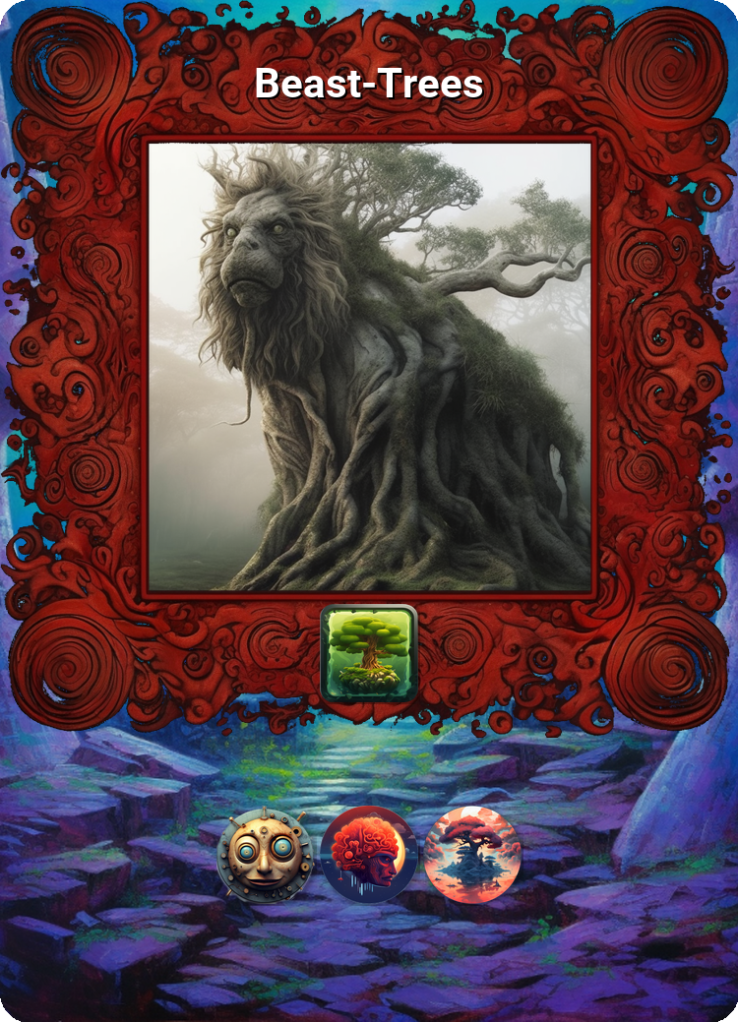
This is an Encounter card, which represent the weird shit that the team of explorers come across as they explore alternate Earths. The name of the card and the image are self-evident. The tree icon indicates that this encounter can only happen in a biome with an icon that matches that type. The row of icons below are the Struggle icons. In the game, the players should match those icons with their player cards to consider the encounter beaten. Those struggle icons depicted are Emotional, Cognitive and Environmental respectively.

Images courtesy of Midjourney, of course.

Here are some Biomes:

I know that the icon designs don’t match each other, but whatever.

I must thank again the most powerful large language model we have access to: GPT-4. It’s like having an extremely knowledgeable veteran programmer ready to help you at all times. For example, an hour ago I thought that the icons could use some subtle drop shadows. I had no clue how to even begin programming that, so I just asked GPT-4. After a short back and forth (in the first attempt it dropped shadows for the invisible part of the alpha channel), the icons now drop perfect shadows. How about that?

I have already started working on the Rust version of the game, using the Bevy crate, which seems to be the most advanced game development engine in that language. I have displayed a few encounter cards that move smoothly to the center of the screen for no particular reason other than that I wanted to figure out how to move stuff smoothly on screen.

Next up, I’ll focus on developing the necessary cards and Rust systems to make the following happen:

  • Design and generate an Exploration Zone card, which are the cards that determine which types of Biomes and Encounters can show up during an exploration (only those with matching icons can).
  • Display the Exploration Zone card in Rust.
  • Write the code to build the Biomes deck with only matching Biomes.
  • Display the Biomes deck on screen in Rust.
  • Write the code to build the Encounters deck with only matching Encounters.
  • Display the Encounters deck on screen in Rust.

Interdimensional Prophets – Deckbuilder (Game Dev) #1


A couple of weeks ago I kept myself busy programming an exploration game based on an old free verse poem of mine. I had developed the core of the game, the encounter system, when it became obvious that for the game to feel remotely compelling (even for myself), I’d have to manually develop dozens or hundreds of encounters. The game as it was conceived couldn’t continue past that point, so I thought about what I liked the most about that concept:

  • A team of players cooperating to solve some issue.
  • Each player having special abilities.
  • Gaining resources, abilities, etc, for one of the players at a time.
  • Exploring strange places.
  • Encountering weird shit.
  • Events that could alter how some encounters play out.
  • Gaining injuries, diseases, etc.
  • Gaining mental afflictions.
  • Being able to regroup at the hub and determine the resources that would be used for the next exploration.

Damn it if that isn’t a deckbuilding game. Not surprising, given that one of my favorite games ever is Arkham Horror LCG, a card game in which a team of at the most four players, each with his or her deck, uses the resources and abilities contained in that deck to solve perilous situations and beat weird monsters. It also features a location system that forces the team to move around, although that’s probably my least favorite part of the game.

So I thought, why can’t I program a deckbuilding game?

First of all, I need a fast system to produce cards. I had looked up programs to create cards in the past, and I was extremely disappointed due to how obscure their usages were. So I would need to develop one such program myself, tailored to the needs of my game.

So that’s what I’ve begun to do thanks to the insane Python skillz of ChatGPT. Behold the repository with the current version of my card generator:

Link to the GitHub repository for the card generator program

The first notion I had of such a program is that it should be able to take a background image, a card image, a frame image, and the necessary text, and generate a standard-sized card immediately. And so it does:

Yes, the cards even have rounded corners. Isn’t that fucking cool?

I have become emboldened by the fact that I could get this far in a few hours. So to come up with ideas I have relied on the current king of mini-AGIs (artificial general intelligences), that for me is godmode.space (requires a plus subscription to OpenAI and an API key; I had to wait for mine). Such AGIs are able to make plans, determine what tasks to perform, and criticize their own performance, in the pursuit of fulfilling some goals you’ve told it to focus on. As I’m writing this, GPT-4 is running in the background, coming up with game ideas and mechanics for the notions I fed it. For example, these are some of the texts that GPT-4 has written:

  • An Afflictions deck will be created, which will add an element of chance and difficulty to the game. The deck will consist of afflictions such as injuries, diseases, and mental statuses that will be detrimental to the player when drawn. The severity of each affliction will be determined, and a variety of afflictions will be included to ensure that the deck does not become predictable.
  • Illusion: A card type that represents deceptive, disorienting elements a player might encounter on specific biomes. These cards could have effects that remove enemy cards from the encounter deck or switch the order of Biome cards in the Biome deck.
  • A card drafting system will be developed to allow players to choose which cards to add to their deck when trading resources. The system will allow players to have more agency and control over their deck, and add another layer of strategic thinking to the gameplay. The rules for the drafting system will be determined, such as how many cards are presented to the player, and how many of those cards can be added to their deck. The card drafting system will be tested to ensure that it provides an engaging level of strategy without compromising the overall gameplay.
  • Encounter cards will be matched with one or more features of the Exploration Zone card in play. This will reflect the biome, geography, or climate the team is exploring, making the game more interesting and exciting for players. Additionally, we will develop a mechanism for how Encounter cards are ‘beaten’ through spent Player cards that feature certain icons. This will give players more agency in the game and create more engaging gameplay.

Born too late to explore the Earth, born too early to explore space, born just in time for the AI revolution.

Repository for word-information-generator

Yesterday I made a blog post about developing a program in Python that provided plenty of useful information given any word passed as a command-line argument. Well, the program seems feature complete now, so I have created a GitHub repository for it (to be honest, I should have created one from the beginning, as I had to backtrack some severe changes). Anybody who knows how to run Python programs should be able to use it. Otherwise, the instructions given on the repository might be enough.

Link to the GitHub repository for word-information-generator

I have been running the program already while writing my current novel. Along the way, if I realize that I want the program to offer me further information, I’ll likely add that in, so there may be further updates in the future.

Interdimensional Prophets (Game Dev) #6


I had finished programming the non-visual part of Team Struggles (a part of the encounter system that involves character traits and psychological dimensions against some performance thresholds) when I faced the fact that the game was loading too damn slow. I admit, I have been a bit overeager demanding more anime photo IDs from Midjourney, and they are completely unoptimized, but still, I figured that this project could load much faster. So I figured the following solutions:

  • Lazy loading. Instead of loading encounter, biome, and photo ID images at once, just the image path is registered. Right before I need to draw a certain image, I check if it has been loaded, and if it hasn’t, I load it. That makes it so that the many images that won’t be seen in a particular testing session won’t need to be loaded at all. This change alone has sped up game loading significantly.
  • Multithreading. This project didn’t feature any multithreading up to this point, as it is a static, 2D strategy game, but the process of loading the various parts (most of them from TOML files) could use some multithreading. My previous experience with this subject involved trying to develop a Dwarf Fortress-like simulation in Python, only to realize that Python isn’t suited for multiprocessing, nor remotely big simulations at all, due to its garbage-collected nature and a core that is locked to a single thread. However, Rust has mature crates that make multiprocessing relatively simple.

I asked GPT-4 to give me an overview of multiprocessing in the Rust programming language. It suggested a combination of the “rayon” and “crossbeam-channel” crates. The process works like this:


let (sender, ecs_receiver) = crossbeam_channel::unbounded();


You declare a sender and a receiver. The sender part will put on a queue the work done from a different thread, and the receiver will remain on the main thread to try to figure out what it can extract from the queue. However, those threads don’t need to disconnect: they are open channels. I assume that you could have a dedicated thread pumping out pathfinding-related calculations back to the main thread.

Spawning a thread is as easy as the following:

       std::thread::spawn(move || {

            load_ecs_threaded(sender);

        });

The “move” order, or whatever you would call it, is tricky. Any information at all that you are sending from the main thread changes its ownership, even if you clone it normally, so you need to use the “Arc” library to clone it in some special way. Not sure how expensive it is.

Anyway, “load_ecs_threaded(sender)” is in this case the function that will run in the spawned thread. The definition and contents are the following:

use crate::{

    gui::image_impl::ImageImpl,

    world::{create_world, ecs::ECS},

};

pub fn load_ecs_threaded(sender: crossbeam_channel::Sender<ECS<ImageImpl>>) {

    sender

        .send(create_world::<ImageImpl, ECS<ImageImpl>>())

        .unwrap();

}

That function merely sends through the sender the results of the “create_world” function, that registers all necessary components with “specs” Entity-Component System.

You won’t be able to check if the spawned threads have done anything unless you are running some sort of loop on the main thread. In this case I’m running the game with the 2D game dev “ggez” crate, which operates a simple, but well-working, game loop. From there, you need to rely on the “receiver” part of the channel to try to receive data:

        if let Ok(ecs) = self.ecs_receiver.try_recv() {

            match self.shared_resources.try_lock() {

                Ok(mut bound_shared_resources) => {

                    bound_shared_resources.set_ecs(ecs);

                    self.progress_text = Text::new(“Loaded Entity-Component System”.to_string());

                }

                Err(error) => return Err(GameError::CustomError(format!(“Couldn’t lock shared resources to set the world instance. Error: {}”,

                error))

                ),

            }

        }

Through the call “ecs_receiver.try_recv()” I will get either an Ok or an Error. An error may just be that the channel is empty because the remote function hasn’t finished working, so we just check Ok. In that case, the thread has finished doing its job. We gather the results (the “ecs” in this case) and store it into our shared_resources as I did previously.

That’s all. You need to be careful, though, because there are some structs that you can’t send through channels. For example, you can’t send the graphical context of “ggez”, meaning that you always need to load images in the main thread. You also can’t send the random number generator through, as it’s explicitly working on a single thread. But I haven’t found any issue sending my game structs.

Now that the game doesn’t seem to freeze on launch, I can focus on implementing the visual aspect of Team Struggles.

Interdimensional Prophets (Game Dev) #5


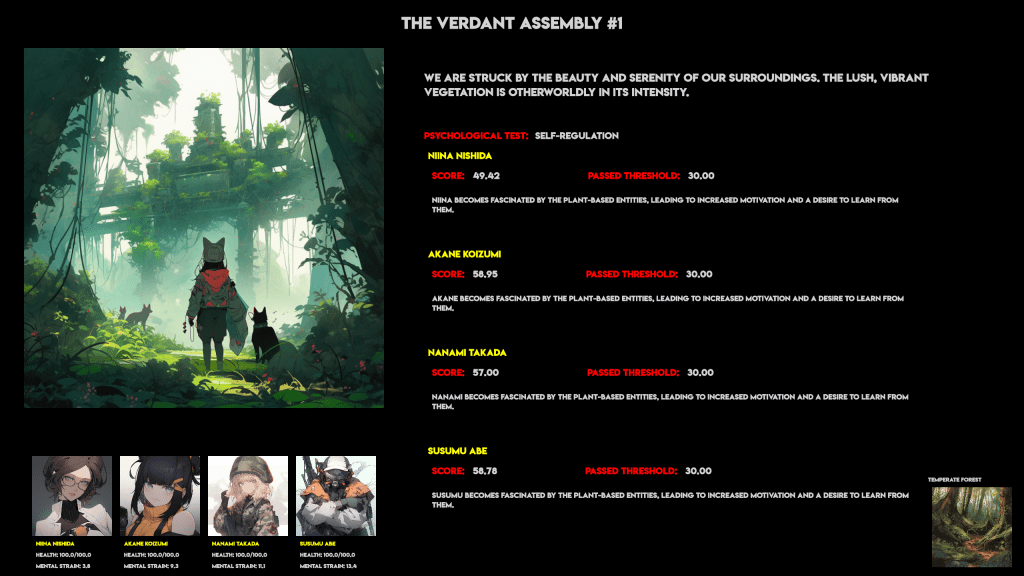
A couple of entries ago I presented my first version of the encounter screen. As the team of explorers wanders around in the map, the stored encounters will get shuffled, and the first one whose condition gets triggered will present itself. Here’s the somewhat updated screen:

I was checking out the moddability of this game by changing most pictures to manga/anime aesthetics, and I realized that I liked it more this way. With a simple change of directory names, all names and pictures could get swapped to American ones. In any case, this screen presents what encounter has been triggered. The description gives a brief overview of the situation. The rest of the text informs that this encounter, at least the psychological part of it, will test each team member’s self-regulation (which is one of the psychological dimensions, the grouping of a few psychological criteria).

Yes, I know that there’s a lot of black space. Don’t know what to do about that.

Once you click the round button on the lower right, you are shown the results of the psychological test:

A brief text indicates the reason of this psychological test; in this introductory event/encounter to a narrative line called “The Verdant Assembly,” the characters test their self-regulation against the overwhelmingly lush and alien surroundings. For each character, the average value for that psychological dimension gets tested against a series of performance thresholds in the TOML files. The highest threshold they pass, they get that reward (or punishment). In game terms, an Encounter is associated with a series of Outcomes. Here’s how the outcomes for this encounter look like in the raw TOML file:

# Possible placeholders:

#

# {CHARACTER_NAME}

# {CHARACTER_FIRST_NAME}

[[outcomes]]

identifier = 1

outcome_type = “PsychologicalTest”

description = “Overwhelmed by the alien nature of this plant-based world.”

consequences_identifier = 1

[[outcomes]]

identifier = 2

outcome_type = “PsychologicalTest”

description = “{CHARACTER_FIRST_NAME} becomes fascinated by the plant-based entities, leading to increased motivation and a desire to learn from them.”

consequences_identifier = 2

They are self-explanatory. The most important part is that they link to another store of game entities, the Consequences. I intended to unify the concept of game consequences to a single block of game logic that could be applied to psychological tests and, in the future, to team struggles. The TOML file of related consequences is the following:

[[consequences]]

identifier = 1

illness_identifiers = []

injury_identifiers = []

mental_status_effect_identifiers = [1, 2]

character_trait_identifiers = [1]

add_features_identifiers = []

remove_features_identifiers = []

[[consequences]]

identifier = 2

illness_identifiers = []

injury_identifiers = []

mental_status_effect_identifiers = [3]

character_trait_identifiers = []

add_features_identifiers = []

remove_features_identifiers = []

It is quite inexpressive in its contents because it only links to other entities through their identifiers. However, the outcome of each psychological test and team struggle could have any of the following consequences (or all of them):

  • The team member(s) involved receives one or many illnesses. Illnesses reduce the team member’s health every turn until they run out or are cured.
  • Receives one or many injuries. Instant reduction of health, and the permanent ones even reduce max health.
  • Receives one or many mental statuses (like Confused or Discouraged). They increase or reduce the value for associated psychological criteria.
  • Receives one or many character traits (like Terrified of Octopi, or Botanist). These help or hinder during team struggles.
  • The exploration zone the team is exploring either gains or loses features. For example, if some outcome enrages the natives, the exploration zone could gain the feature Enraged Natives, which would present more combat-oriented encounters in the future.

The consequences are already being applied in the code (which was some heavy amount of code, well-tested thanks to test-driven development), and once I get around to implementing team struggles, their consequences will work seamlessly with the code already written.

In the near future I’m going to focus on making sure that encounters can be blocked by other encounters or even their outcomes, if necessary. For example, if during a team struggle the team screws up bad enough to unleash something dangerous, that should cut off access to more positive branches of that same narrative.

A detail about Rust’s fastidious nature: this is a programming language built upon security and protection against the nastiest bugs from the C++ era. As far as I can tell, in Rust it’s impossible to corrupt some memory allocation that it wasn’t supposed to touch. That forces you to change your approach to programming in quite a few ways, but not because Rust is annoying for no reason, but because in other languages you were doing dangerous things. In my code, I was passing around a SharedGameResources entity that had access to “specs” Entity-Component System (that’s a whole thing; if you are interested, google it) as well as the stores of data loaded from TOML files. At one point I had to borrow that SharedGameResources entity both as immutable (just to read from the stores) as well as mutable (to write the results in the components). That’s impossible. Although it forced me to rewrite some basic architectural code, it illuminated the point that stores of game systems (like the “databases” of mental status effects or of character traits) are separate to the Entity-Component System, which handles a lot of mutation. In the end, Rust’s compiler steers you towards proper architecture, because you simply can’t run your program otherwise.

Interdimensional Prophets (Game Dev) #4


As I was writing unit tests for a perilous, convoluted part of the game logic, which I wanted to lock in place as I moved forward, I realized that to test one relatively small part of the code, I would need to create both World, the main entity of the Entity-Component System “specs”, as well as Image, which is tied to the Context of the 2D game dev “ggez” crate. World is heavy by itself to fire up for a simple unit test, but Images themselves may not even be feasible, as they are glued to the graphical context (no graphics should run during unit tests), and they are tied to a single thread, while the unit tests run in all CPUs.

Therefore, I came to the dreaded conclusion: I needed to refactor their entire code into traits (interfaces). Traits are contracts that encapsulate a behavior without implementing anything. If you program to traits (interfaces) instead of to classes, you are working with future, potentially unimplemented structures whose details are irrelevant to you or the compiler, because they are only forced to fulfill a contract (the trait/interface). It’s like telling an animal to say something; a dog would bark, a cat would meow, but both have fulfilled the contract of “talking,” which is apparently all you cared about.

It just happens that traits in Rust involve generics, and generics in Rust are unholy. Due to Rust’s welcome but tough borrowing rules and lifetime whatevers, Refactoring any behavior to traits involves dealing with bizarre generic declarations, and worse yet, nearly incomprehensible lifetime signatures.

Behold the horror:

pub struct MainState<‘a, T: ImageBehavior + ‘static + std::marker::Send + std::marker::Sync + Clone, U: WorldBehavior<T>> {

    active_stage: Option<GameStage>,

    base_state: BaseState<‘a, T, U>,

    expedition_state: ExpeditionState<‘a, T, U>,

    encounter_state: EncounterState<‘a, T, U>,

    shared_game_logic: Arc<Mutex<SharedGameLogic>>,

}

That’s the definition of MainState, the head honcho of the state machine that figures out which other stage needs to update, or draw on the screen. It declares that it’s somehow involved, to start, with an ImageBehavior contract. Every image throughout the program, except in the launcher, is now unaware of what type of structure it’s actually dealing with, except that it fulfills the contract of being static (I assume images are fixed in memory or something), they Send and Sync for multithreading, and can be Cloned. That’s the hardest one. Then we have WorldBehavior, which abstracts away the entirety of the “specs” Entity-Component System into a wrapped class. The resulting contract for WorldBehavior, if I may say so myself, is a thing of beauty:

pub trait WorldBehavior<T: ImageBehavior + std::marker::Sync + std::marker::Send + Clone> {

    fn new(world: World) -> Self;

    fn join_coordinates_and_tile_biomes(&self) -> Vec<((i32, i32), TileBiome)>;

    fn retrieve_player_coordinates(&self) -> Option<(i32, i32)>;

    fn retrieve_biome_at_player_position(&self) -> Option<Biome>;

    fn retrieve_unique_character_traits_of_team_members(&self)

        -> HashSet<CharacterTraitIdentifier>;

    fn count_team_members(&self) -> u32;

    fn calculate_average_mental_strain_of_team(&self) -> f32;

    fn calculate_average_health_of_team(&self) -> f32;

    fn set_player_position(&mut self, x: i32, y: i32);

    fn retrieve_player_entity(&self) -> Entity;

    fn retrieve_name_of_entity(&self, entity: Entity) -> Name;

    fn retrieve_psychological_profile_of_entity(&self, entity: Entity) -> PsychologicalProfile;

    fn retrieve_health_of_entity(&self, entity: Entity) -> CharacterHealth;

    fn retrieve_team_members(&self) -> Vec<Entity>;

    fn retrieve_team_members_except_player(&self) -> Vec<Entity>;

    fn retrieve_photo_id_of_entity(&self, entity: Entity) -> PhotoId<T>;

    fn move_direction(&mut self, direction: Direction);

    fn create_entity(&mut self) -> EntityBuilder<‘_>;

}

With that contract in place, there’s no more need to deal with “specs” way of working. You want to retrieve the player entity? Call “retrieve_player_entity”. Do you want a calculation of the average mental strain of the entire team? Call “calculate_average_mental_strain_of_team”. Of course, the contract can be developed further as more information or calculations need to be gathered.

I’m at ease now that I have managed to refactor those two unit test blockers into behaviors, but it took hours, and if it weren’t for the indefatigable help of GPT-4, I wouldn’t have been able to do it. But thankfully there shouldn’t be any major obstacles to unit test every part of the code now, which should speed up development significantly.

A boring entry compared with the three previous ones, perhaps, but programming is a fight against entropy: the further you build your system, the harder it becomes to change. You have to stop every few days (if not once a day) to make sure that some part of the code isn’t rotting already.

Interdimensional Prophets (Game Dev) #3


The core loop of this game/experiment of mine consists of the encounter system. As the team of explorers (consisting of four members for balancing reasons, like in Arkham Horror LCG) ventures through strange new worlds, they will face encounters (psychological tests, team struggles) in the following circumstances: either the player ends the turn deliberately, or he/she moves the team to a different tile. That will trigger the code to shuffle the potentially very, very large list of encounters loaded from a TOML file, and then a complex function will determine which will be the encounter that the team of explorers will face based on numerous conditions.

The following is an example encounter from the TOML file, that gets loaded to the game on start.

encounters.toml

[[encounters]]

identifier = 1

title = “A New World”

image_path = “/resources/encounters/1.png”

description = “We have made it. Nobody believed we would manage to create a portal to a multiverse, but here we are, in this strange new world. I take a deep breath as I gaze at the field of grass.”

duration_in_turns = 1

encounter_condition = 1

psychological_test_identifier = 1

[[encounter_conditions]]

identifier = 1

requirements_biome_identifiers = [1]

requirements_feature_identifiers = [

    { AnyRequired = [] },

    { AllRequired = [] },

    { AnyExcluded = [] },

]

requirements_encounter_identifiers = [

    { AnyPreviousEncounter = [] },

    { AllPreviousEncounters = [] },

    { AnyExcludedEncounter = [] },

]

requirements_trait_identifiers = [

    { AnyRequired = [] },

    { AllRequired = [] },

    { AnyExcluded = [] },

]

team_size_requirements = [

    { MinimumTeamSize = 1 },

    { MaximumTeamSize = 6 },

]

team_overall_mental_health_requirements = [

    { MinimumTeamOverallMentalHealth = 0.0 },

    { MaximumTeamOverallMentalHealth = 100.0 },

]

team_overall_health_requirements = [

    { MinimumTeamOverallHealth = 0.0 },

    { MaximumTeamOverallHealth = 100.0 },

]

time_spent_in_alternate_earth_requirements = [

    { MinimumTimeSpentInAlternateEarth = 0 },

    { MaximumTimeSpentInAlternateEarth = 10 },

]

Each encounter is, so far, associated with a psychological test, but soon enough they will be associated with a team struggle as well. The most important part of an encounter is the conditions for it to trigger, which can be the following:

  • The current biome is any of the required (obligatory: all encounters should be attached to at least one biome).
  • The features associated with this exploration zone (ex. NativeInhabitants, Irradiated) are compatible with the any/all/excluded specifications.
  • The list of previous encounters is compatible with the any/all/excluded specifications. This should allow for story-like threads of narrative that depend on previous “chapters” having been passed.
  • The combined list of character traits (from all team members) is compatible with the any/all/required specifications.
  • The team size should be between the set values, if any.
  • The team’s overall mental health should be between the set values, if any.
  • The team’s overall health should be between the set values, if any.
  • The time spent wandering in the current exploration zone should be between the set values, if any.

This allows, for example, for encounters with mythical beasts that only inhabit certain biomes, maybe during some lunar condition (which would be a feature), and only when the team of explorers has trackers (which would be a character trait). Also, when the team’s mental health is deteriorating and their overall health is becoming dangerous, encounters about the team stopping to rest and heal could pop up.

When an encounter triggers, the user is presented with the following window:

I’m not an interface man. I need to figure out which background color would be preferable to plain black, but white and such other clear options seem too grating to me. Anyway, the photo on the upper left is the one associated with the encounter. The row of photo IDs under that is the team of explorers, starting with the player. Regarding text, there’s the title, a short description (thankfully you can program text wrapping). A blue text that you can barely distinguish from here announces that there’s a psychological test associated with the encounter, and that it tests the following psychological dimensions: cognitive abilities and interpersonal skills. Then the values of those psychological dimensions are displayed for each team member.

In the lower right you get a reminder of what biome you are currently in (in this case, a temperate grassland). The fancy button to its left is the one to trigger the psychological test. I have already written the code to gather all the results, which will appear under the description of the encounter.

Thank you Midjourney for the effortless AI images. Regarding GPT-4, I make a point of bothering it by presenting my code and asking “this represents an Outcome given [game concept]. Can you offer any suggestions and improvements?” The AI is eager to point out what I’ve done wrong, with no regard to my feelings. As such, it has proven to be an invaluable tool while programming. Also, when I suspect there’s more to squeeze out of a concept (such as psychological tests, team struggles, outcomes, etc.), I ask GPT-4 if it can come up with more features for that concept, and more often than not, it provides very valuable insight.

Anyway, I have been feeling guilty because I’m mainly a writer and I have neglected my novel for a week. I think that for the foreseeable future I will write one day, program the next. Programming is very addictive for the obsessive mind I was born with, as long as you don’t end up in some ditch of which you don’t know how to climb out.

Interdimensional Prophets (Game Dev) #2


Although I had managed to develop the code to load environments (now called exploration zones) from a Lua file, to pick one and then create a map using the biomes that the exploration zone allowed, the process of loading relatively simple data from Lua annoyed me. It seemed way too complex for this day and age, even though GPT-4 wrote most of the code helped me. I asked the AI for preferable alternatives, and it suggested either JSON files or TOML ones. TOML seemed fancier and better somehow (I have already forgotten the reasons), so I have spent some hours going through the somewhat grueling process of destroying the basic code that worked, to improve the system.

Thankfully, deserializing TOML files to Rust instances is trivial thanks to the “serde” crate. In addition, it had worried me that the process of adding a new type of biome or a feature (some aspect of the exploration zones, like bad weather) required me adding a new element to the corresponding enum, which meant that no user of the game (meaning me for the most part) would be able to add new biomes nor features without access to the code. Obviously that’s terrible for modding; the holy grail of modding consists on having every piece of game data exposed to be fondled by the greasy fingers of the users.

Behold the TOML files that now store all the game data for biomes, features of an exploration zone, and the exploration zones themselves (obviously the data itself is made of examples):

biomes.TOML

[[biome]]

identifier = “temperate_grassland”

name = “Temperate Grassland”

description = “A biome characterized by rolling grasslands and few trees.”

[[biome]]

identifier = “sky_islands”

name = “Sky Islands”

description = “A biome consisting of floating islands high in the sky.”

[[biome]]

identifier = “alpine”

name = “Alpine”

description = “A biome consisting of high land and some pines.”

features.TOML

[[features]]

identifier = “haunted”

name = “Haunted”

description = “a supernatural presence, allowing encounters with ghosts.”

[[features]]

identifier = “ancient_ruins”

name = “Ancient Ruins”

description = “contains the remains of an ancient civilization, with hidden treasures and traps.”

[[features]]

identifier = “unstable_geology”

name = “Unstable Geology”

description = “frequent earthquakes and volcanic activity, posing geological hazards for the team.”

[[features]]

identifier = “radioactive”

name = “Radioactive”

description = “high levels of radiation, potentially causing health problems and mutating local flora and fauna.”

exploration_zones.TOML

[[exploration_zones]]

identifier = “zone_1”

name = “Verdant Valley”

description = “A lush valley with dense forests, clear rivers, and abundant wildlife.”

allowed_biomes = [“temperate_forest”, “river”, “temperate_grassland”]

features = [“rich_flora”, “native_inhabitants”]

[[exploration_zones]]

identifier = “zone_2”

name = “Frozen Tundra”

description = “A vast, frozen wasteland with treacherous ice and snow, and sparse vegetation.”

allowed_biomes = [“tundra”, “ice”, “glacier”]

features = [“extreme_cold”, “limited_visibility”]

From now on, as long as the identifier of a biome written in the exploration_zones TOML file matches with an entry in the biomes TOML file, the game will work properly and use that biome (and its image). If not, the game will burn to the ground (in Rust’s terms, it will panic).

Now I will move on the encounter system, which is composed of various steps:

-A very complex determination of whether or not any given encounter will trigger (can depend on certain biomes and/or features and/or previous encounters having been seen and/or the team members having certain traits and/or the team size being between a certain range and/or the team’s average mental health being between a certain range and/or the team’s overall health being between a certain range and/or the time spent exploring being between a certain range. That code is already written and is the most unit tested area of the game so far (thanks to GPT-4).

-If an encounter triggers, then each team member should go through a number of psychological tests. For example, having walking octopi wanting to drink your blood may test their self-regulation and/or coping skills. The outcomes are on a range of thresholds, so worse outcomes should cause worse consequences, and so on. Those will also end up as TOML files.

-After all the psychological tests pass, there should be one or more team tests. The way these tests work, the best one that GPT-4 and I have come up with, is adding beneficial character traits * their individual weight against negative character traits * their weight, and applying outcomes based on a range like in the case of the psych tests.

If that psychological test thing followed by team test reminds you of something, yes, I was inspired by the Arkham Horror LCG, my favorite card game. In that game, before your turn starts, you are forced to deal with some nefarious encounter (it’s always unnerving to see that card coming from the deck) that you have to face with your abilities. The encounter can make you lose sanity and/or health, or who knows what other horrors. Afterwards you can act with your cards, and other players can get involved if you share a location with them. Hence my notion of a round of psychological tests followed by a team test/struggle.

I won’t go through the trouble of creating a anything visual for this encounter system until it works well in the console and is well-tested. The encounter system seems like the toughest nut to crack of this game, and I’m for one excited to face how to implement it.

If you, whoever the hell you are reading this, can come up with some idea for this game, please tell me. If it’s good, I’ll implement it. Otherwise I’ll yell at you and call you stupid.