Smile, Pt. 4 (Fiction)

I followed him inside. The apartment was painted parrot green. Two fans droned away, airing it out. Even next to this individual, I preferred the indoors to the barbecue-like heat outside.

“Small,” the man said. “It’s hard for me to guarantee steady income. But I develop the photos at home and don’t need much else.”

The kitchen had been installed on the short side of an L-shape, whose long side was the living room. The man set his grocery bag on the counter. I wanted to run to the sink and soak my face, or take a ten-minute shower in cold water. On the kitchen table, next to a bowl with milk and cereal leftovers, lay two pieces of plaster, like the cracked shell of a walnut, and a hammer.

“Remodeling?” I asked.

The man stepped toward me, casting a sidelong glance at the hammer.

“I needed to bash something. Arms up, friend.”

I raised an eyebrow. He made a gesture like surrendering to the police. When I obliged, he patted down the underarms of my jacket, searching for holsters. He checked the sides of my belt, then stepped back and rubbed his chin.

I straightened my jacket.

“Your potential employers come armed?”

He moved past me into the living room.

“After they booked me, a guy tried to stab me. You never know.”

He led me to the back of the room, partitioned by an orange velvet curtain with patterns like something that might emerge under the influence of hallucinogenic mushrooms. He pulled the curtain aside. On a table, he had left two cameras, three plastic trays for soaking negatives, and a lamp fitted with a red bulb.

The man slid the curtain closed, plunging us into inky darkness. The fans droned like a generator. My stomach turned, and the hair on my forearms prickled. After two steps and the press of a button, the lamp’s bulb struggled to ignite like an old engine, then bathed us in fluorescent blood-red light. His blond hair, skin, and teeth, even his pupils, all took on the hue of a cartoon demon.

“I’ve gathered what I need in this nook,” he said. “The magic depends on how you treat women and on framing, and you can’t buy that. People like you just rent it for a while.”

He opened a cabinet. Inside were five albums stacked up.

“Want to take a look at this year’s work?”

“Sure.”

He pulled out the first album. The look on his profile hinted at the pride he took in showing it off. When he opened the album, I glimpsed three rows of photos per page: gorgeous faces emerging from beneath cascades of hair, voluptuous bodies posed in varying degrees of undress, all tinted red.

He snapped the album shut.

“We’ll need a different light.”

With the album tucked under one arm, he switched off the bulb, and slid the curtain open. The living room consisted of a coffee table he’d pushed against an old sofa and a wicker chair. He might have bought them at a flea market or salvaged them from a dump. Concert posters hung on the walls, including a stand-out shot of Hendrix in a fancy jacket, laughing as he held his guitar. Above the sofa, a poster of Kubrick’s take on Lolita: the close-up of a pale girl donning heart-shaped sunglasses and clutching a lollipop to her cherry lips.

I nodded toward the piece of furniture where he’d set up a Thorens TD-125 turntable. In the open space below were about twenty vinyl records in their sleeves. Atop the turntable lay a record sleeve showing a cloud of pink smoke escaping a subway entrance—an album by The Velvet Underground.

“Nice setup for that other hobby of yours.”

“Photography’s my job, but yeah, you can’t live without music. And there’s never been better music than now.”

He set the photo album down on the coffee table. I sat in the wicker chair, which creaked as though riddled with termites.

“You must be surprised,” the man said.

“No. I love music.”

“There’s no TV. My guests always bring it up. They need the box that tells them what to think.”

“That’s a point in your favor.”

The muscles around his eyes helped shape his smile.

“Something to drink? A beer?”

“As long as it comes out of the fridge, anything works.”

He walked away and turned the corner that concealed half the counter, the oven, and the refrigerator. One of the fans rotated toward me, cooling my face. On the piece of furniture opposite the couch, the man had stacked a dozen books. Now that I was calmly looking around, I read the titles on the spines: Beyond Good and Evil by Nietzsche, Parerga and Paralipomena by Schopenhauer, the Bible, Story of the Eye by Bataille, Down There by Huysmans.

I heard a drawer slide open, some utensils clatter, then the drawer slam shut. The man reappeared clutching two bottles by their necks, and a bottle opener. He slumped onto the sofa, in front of the photo album. With the opener, he popped the cap off his beer.

“One of the greatest sounds.”

He took a swig.

“And the best one?” I asked.

He wiped his lips and glanced aside.

“A secret.”

He tossed me the opener in a smooth arc. I opened my beer. As I drank, the bitter brew ran down my throat and settled in my stomach, cooling my insides the way flash floods scrub dry riverbeds.

The man opened the album halfway and turned it so we could both see. I studied the photographs, flipping through several pages. A blonde woman with cobalt eyes, nude and seated on a king-size bed, had tilted her face away from the camera in a calculated pose. A woman with wavy brown hair, kneeling on the bed, looked over her bare shoulder as though inviting the watcher; her half-lidded eyes suggested she might have been high. The same woman standing on the mattress or on a carpet, striking ballet poses. A necklace of wooden beads strung on a bronzed wire reached between her pale breasts. Another woman wore a salmon-colored blouse, and the ends of her hair flipped upward, mimicking the style shown in magazines and on TV. She was smiling as if mustering the courage to undress. The same woman leaned against a window that cast back her phantom-like reflection. She had slipped into a dress a size too big, and one strap had slid off her shoulder. Other photos caught this woman mid-conversation, her face suggesting she was talking to a friend. Another woman, her dyed-blonde hair tied into pigtails, knelt naked in front of the camera, looking up with the confidence of someone who knows her beauty. A woman silhouetted against an unlit spotlight had black hair streaked with glints of midnight blue, her gaze roaming the room as though familiarizing herself with her surroundings.

The sun washed out half the face of a little girl who was tucking a strand of hair behind her ear. A nude woman lay on the couch where the man was now seated. Huge headphones covered her ears, and her eyes were closed to listen more intently. A father, a boy, and a girl stood under a spray of water pouring from one of the Venice Beach showers, against the backdrop of the ocean and a lifeguard station. One photo captured a woman from her bangs down to the top of her breasts. She had rested her head on a pillow, and her lips glistened with moisture. A woman dressed as though she were out for a Saturday stroll posed shyly in front of blurred branches resembling a tattered curtain. The pigtailed girl, topless, sat in front of this apartment’s record collection, her hands pressed against her headphones. A series of pictures showed women in wet hair and swimsuits, outlined against water like molten metal where the sun had burned white holes.

I imagined these women living on for centuries. Wearing the same clothes and accessories, their skin immune to wrinkles, their expressions forever fresh. A secret community bound by the knowledge that they all once confronted the same camera lens. Perhaps I would find the bed, apart from the lights that had illuminated many of these shots, in whatever place the man and his aspiring model were heading to yesterday.

The man rubbed his chin as he nodded.

“Fascinating, isn’t it? How everyday life differs from those moments immersed in the ritual. The camera knows. If you saw many of these women on the street, you’d walk right by, but in the photos, they’re goddesses. And they’ll endure until the pictures turn to dust.”

I locked my eyes on his. When he noticed, he raised his brows. He tipped up his beer bottle and drank.

“How many of these women have you slept with?” I asked.

He laughed as he swallowed. After giving himself a thump on the chest, he bent forward, elbows on his thighs, and shot me a roguish smile.

“Trade secret. Pretty unprofessional of you to ask. But women open up to whoever makes them feel beautiful.”

I drank half my beer, swished the bitter liquid in my mouth, swallowed. I set the bottle next to the album and leaned back against the wicker chair.

“How many of these women are still alive?”

He gave me a once-over, imitating the way his future prey had scrutinized me yesterday, trying to figure out if I was joking.

“When they leave my studio, they vanish into the jungle.”

“You really don’t know if any of them dropped dead around the time they met you?”

He soured like a kid who just unwrapped the box for the game console he wanted, only to find socks inside.

“You drop remarks like you did yesterday. I get your perspective, but airing it is pointless. Do you think people want to stay close to someone who dredges up that stuff?”

“I don’t want them close. How many of these women walked into your studio, got photographed, and disappeared? How many families are searching for their daughters?”

His lips parted in a dark slit. His brow furrowed, and his face lost some of that California tan. He stood up straight. From his shirt pocket, he yanked out three fifty-dollar bills and slapped them onto the table.

“Your mind is twisted. I ignored the vibe you were giving off, but I should’ve refused the job the moment I realized who was offering it. Money corrupts—blinds you, blinds me too. Out. Don’t ever contact me again or show your face around here.”

“I’m staying for now.”

He held his breath, closing the fingers of his right hand on his knee so hard that his knuckles pressed white against the fabric.

“You think you can stay when I forbid it?”

“I’ll say what I have to say and then leave.”

The man squared his shoulders. His right fist trembled. A tendon in his neck bulged like a strip of wood.

I primed my muscles, bracing for an attack. While my gaze held his, I also kept an eye on the edges of my vision in case he reached for a weapon.

“Yesterday, July 16, 1977, you followed little Cassie June—doe-eyed Cassie—while she skated home. Maybe you smiled when you offered her a ride to spare her the heat and exhaustion. She trusted you. She got into a stranger’s car because you were kind enough to offer. She was raised to embrace life with a smile, to enjoy the rosy world inside her bubble, before that bubble popped and exposed her to the rancid air of adulthood. Cassie June. She belonged to a dance group with several school friends. Four days a week, she skated. She loved birds and had asked for books so she could learn to identify them. She loved spending afternoons at the beach. Sometimes, sitting on the rocks, she wrote in her journal. She wondered what lay on the far side of that mass of water, and kept saying how badly she wanted to find out.”

The man let one eyebrow drop. His fist unclenched, then tightened again as though trying to recall his anger. I didn’t let the rage quake my voice.

“But Cassie June got into your car. Instead of taking her home, you took her somewhere else. Maybe to your studio, where you shot many of the photos in this album. For two hours you raped her and sodomized her. When you were done, you strangled her until she was nearly unconscious—or with luck she passed out—and then you crushed her face with a hammer. You got rid of the corpse. It destroyed her family, obviously. When they woke up every morning, they remembered the midday they last saw Cassie, a scene that ate at them each night before they fell asleep.”

My red blindness faded as the pounding in my temples eased. The man was smiling like a TV host, a smile that said every hole he had to dodge was already paved over. He knew he had never picked up Cassie June in his Ford Thunderbird just as well as I knew he had—and thanks to me, the evidence for that knowledge was gone.

“You’ve made up one wild story,” he said.

I took another sip. The man did the same, tipping his bottle by fractions of an inch until the last drop trickled into his mouth.

“Those who knew Cassie remembered her as a beacon of joy,” I said. “She signed up for everything. She was inquisitive. Instinctively she got along with everyone she met, without hesitation or fear. The adults in her childhood listened to her, helped her. Whenever she needed them, they were there. People like her, with that innate trust and radiance, can make living in this world worthwhile. But Cassie believed a smiling stranger would drive her home, and that’s why you were able to rape and kill her. California and the West have turned into a hunting ground, open season all year round. If people knew what lurks in the dark, the diet of monsters like you, who would they trust? If Cassie had been afraid of strangers, if she had refused to get into strange cars, would she have been as happy? I don’t think so. Would she have been miserable? Maybe. She would have grown used to fear, to the myriad dangers it signals. But she’d still be alive. What does that mean?”

One fan blew a strand of the man’s hair aside. He looked at me like a blank sheet of paper, wanting to speak but unable to string words together, absently twisting his empty bottle.

“Not long ago, I questioned my role,” I said. “I could crush the trust of people like Cassie, scare them so they never get into strangers’ cars, never walk down dark alleys, never let a slick-talking man with a winning smile charm them. They’d learn they live in a sandpaper world, prowled by evil that would exploit their faith and innocence and grind them to the bone. Or I could keep them from discovering it. I could make sure that evil never reaches them—make sure they get into my car instead of the one behind me. They’d go on dancing, skating, sitting on those rocks by the beach, writing at sunset. Any stray bits of night would remain sedated beneath the anesthesia of their hope. Should I remove monsters like you so that these potential victims can go on living with a smile, still believing this world that almost devoured them is actually worth inhabiting? Is it better to stare into the abyss, or to look away and trust in humanity? Maybe those who see light everywhere must build the world they need, while people like me, the tar-smeared brethren, stand guard around the perimeter, making sure those who’ve drowned in tar don’t choke out that light. I followed that approach for years. And it worked, more or less. It saved thousands. But aside from sparing those people, what good am I really doing? I stand watch at the edges of the darkness, stopping the beasts from slipping into the glow of a streetlamp around which these bright-eyed souls flit. They learn they can let their guard down. They preach that self-defense is a vice or a sin, that monsters can be bought off or cured. I spare them the worst that might happen if they keep wearing those tinted glasses.”

The man reclined on the couch as he rubbed his eyelids, and snorted.

“You see,” I went on, “I found out by accident that this girl existed. I felt lost, torn from where I belonged, all while searching for the albums and classic movies that had bubbled into existence the last time I tangled with the timeline. Then I stumbled upon the news. They found Cassie June’s skeleton in the desert, stuffed in a rusted barrel under a pile of rocks. Usually I steer clear of news like that. The gallons of blood spilled in the darkness as I turn away corrode me, keep me up at night. But I read every article I could find about that girl. They described her life. They interviewed her family—whoever was left. I gathered every fact, every video, the court cases. Most people who heard the story during dinner might have lost their appetite for a minute, but what would that information do for them? They lock it away, forget it by the next day. They accept that the abyss has swallowed another sacrifice and are relieved it happened to someone else’s child. How could anyone keep walking burdened by the weight of so many injustices? Even I manage to let most of these stories pass right through me—otherwise, I might throw myself off a building. But that night, I was drowning in the black tide. Cassie’s murder stabbed me like a lance. I wanted to prevent it, to stop that trusting, life-loving girl from being snuffed out. A window of opportunity had opened, and if I’d refused to step through, I’d have to live knowing I could have saved her but instead swallowed a handful of sleeping pills, crawled into bed, and pulled the covers up to my forehead. I came back to get the job done and avoid Cassie’s ghost trailing after me to my grave.”

I paused for breath, but all the air had fled the apartment. The sunlight coming through the window had dimmed as though a translucent veil had wrapped my head. My body still sank into the wicker chair, but it felt like I was viewing the scene from a few yards beneath it, from the bottom of a pit. I spoke with effort, like cranking up some ancient, forgotten machine.

“It hit me, you know. The lack of meaning. We live for a handful of orbits around this star and then vanish. Some people, whether they deserve it or not, vanish much sooner, before they get to die in a bed surrounded by loved ones. Cassie’s life was cut short when she could have been spared. And that news story tied her to me, this irate beast. Merely annoyances and irritating noises stoke my anger until it boils over, and one day the flames might break out and burn this world to ashes. But my locomotive furnace devours that coal to plow into monsters like you. There have always been Cassies, and there will be more. Anyone you care about can die at any moment—I know that better than most because I live it week after week. It usually comes down to luck. Coincidence. Cassie’s luck was crossing your path. Your luck was crossing mine.”


Author’s note: this novella belongs to a self-published book titled Los reinos de brea (The Kingdoms of Tar), that released about ten years ago. I presented this scene to the writing course I was attending at the time, and those present were disturbed, even the instructor, who is a reasonably famous local mystery writer. I don’t think the scene is that impactful, but I’m glad to find out that I still like it after these many years.

The Deep Dive couple produced an interesting podcast about this part of the story:

Smile, Pt. 3 (Fiction)

At half past ten the next day, in my hotel room, I spread my jacket out on the rumpled sheets and slipped the ammo magazine into the left inside pocket.

I sat down beside the little table that held the phone. I cleared my throat. I picked up the receiver, wedged it against my ear with my shoulder, and dialed the number.

On the third ring, it cut off. I heard the man breathing against the microphone.

“Richard Alcala,” I said.

“You know who you’re calling.”

“The photographer.”

“My reputation precedes me.”

“I was flipping through some old issues of Black Tux. The photos you shot. These women you framed… if you ran into them on the street, you’d notice moles, asymmetry, maybe slack flesh, but thanks to your touch, they’re competing to be the next Marilyn Monroe.”

“You need to update your references, pal. But I remember those shoots. I was born with the gift.”

“I work for a magazine, and we need your gift. You’d coax the beauty out of a dozen or so women.”

“You tempt me, but a personal project has me busy.”

“It’s a well-paid week of work in Los Angeles. I’m sure you could squeeze it in.”

The line crackled as he crunched on something brittle. I pictured him hunched over bloody dirt, naked, caked in grime, gnawing on a femur.

“Have you talked to other magazines in the field?” he asked, voice turning gravelly.

“Yes.”

“And you’re still calling me? Lately, nobody wants to hire me. I bet they rushed to tell you why.”

“You mean your trouble with the law.”

He pulled the receiver away from his face to clear his throat.

“My trouble with the law, yes.”

“Who cares? You’ll take the shots we need. Your previous sessions prove it.”

He fell silent for a few seconds.

“How much?”

“Money? One fifty up front, three hundred at the end of the week. Four or five sessions, depending on a few variables.”

“Your usual photographers turned it down?”

“They don’t shoot like you. Plus, the women will be dressed in outfits many would call pornographic. In this decade, there are still plenty of photographers with outdated scruples. Listen, we need these women to look like Greek goddesses, not like they’re waiting around a street corner at three in the morning.”

“I get you, pal. Bring the money, and we’ll work something out.”

“I’ll drop by around eleven-thirty.”

“Today? I’m busy all day. Starting tomorrow.”

“I’m afraid I leave for Dallas tonight. You sure you can’t spare a slot at eleven-thirty? You’ll pocket the hundred and fifty, and we’ll iron out a couple details.”

A silence swelled on the line, undone by the ringing in my ears—scar tissue from years of gunfire. I heard him close a drawer or a door. Cloth brushed against cloth.

“Eleven-thirty,” he said. “Bring the money. You know the address?”

“I wrote it down before calling.”

At eleven-ten, I spotted the parking spaces outside the two-story building where he lived. Each floor’s facade was lined with doors and windows. Next to the metal stairs going up to the second floor stood two crooked, half-stripped palm trees like birds with plucked necks. The first-floor windows, right at street level, had iron bars.

They’d left a space free next to the Ford Thunderbird. While maneuvering into the spot, I scanned the surroundings in case he was loitering outside. I parked beside the Thunderbird, trunks aligned.

I switched off the engine and got out. Circling to my trunk, I rummaged in one pocket for both sets of keys—mine and the copy that would open the Thunderbird. I sized up the pedestrians drifting down the street as well as the silhouettes moving behind the building’s windows. I slid my key into my trunk’s lock and opened it. An acrid smell of dirt greeted me. As I lifted the trunk lid all the way, I slipped behind the Thunderbird. I inserted the copy of the key and turned it. The trunk popped open a crack.

I bent over my own trunk, grabbed the gloves from the back corner, and pulled them on. I wedged my forearms under the canvas bundle, held down by two bungee cords. Once I lifted it, the weight yanked at my arms, its lumps digging into my forearms and palms. I crouched, like lowering a loaded barbell, set the bundle on the asphalt, and stood up again.

In the apartment next door to his, an old woman in a robe had drawn her curtain aside. She scratched her nose while surveying the foot traffic and passing cars. Once she moved away, the curtain veiled the interior again.

I lifted the Thunderbird’s trunk. It held ropes, two rolls of electrical tape, a shovel, and a can of gasoline. I took the can out, laid it on its side, and pushed it under my car with my foot, metal scraping on asphalt.

I hoisted the bundle in both hands and placed it in the center of the Thunderbird’s trunk. I unclipped the bungee cords. Covering my nose, I turned my head away, unwrapped the bundle, and let the trunk lid fall until it clicked shut.

A tingling spread across my nape. My ears felt tight. I fully expected a line of passersby who’d pelt me with questions, or a group of cops, or the man himself.

I pulled off my gloves, tossed them into my trunk, and shut it. Then I leaned against the back, pressing my shirt sleeve to the sun-baked metal. If he showed up, I wanted to seem casual as I glanced over the street and the building.

Sunlight warmed my hair. Beneath my jacket and shirt, sweat trickled down my spine, probably making my scalp gleam. I crouched by the car’s side and nudged the half-empty gas can farther in with my foot so no one would notice it. I scanned the Thunderbird’s bodywork to be sure I’d left nothing behind. I forced myself not to check the transponder stuck underneath.

“I hope you’re not looking to steal it,” said a voice to my right.

He was walking through the lot with a paper grocery bag in one hand, two inches of a cereal box sticking out the top. He squinted against the glare, grinning like he adored the neighborhood. He wore a tight shirt striped in brass and peanut tones. The oversized starched collar cast triangular shadows. He had it tucked into flared navy-blue pants cinched with a white belt.

I pretended to be admiring the Thunderbird.

“It’s a beauty,” I said.

He set his free hand on the raised center of the hood, stroking it like a dog’s head.

“Best buy I ever made. A V8 engine with three hundred sixty horsepower. Zero to sixty in nine seconds. Never once let me down.”

When he looked at my face, his features slipped out of his control.

“You’re the gloomy guy from yesterday, on the beach.”

“An hour ago, we spoke on the phone about a job I want to hire you for. Yesterday I approached you about it, but we got sidetracked.”

“So that job was for real, I guess.”

I pulled three fifty-dollar bills from my jacket’s other inside pocket. When the sunlight hit the bills, he snatched them, folded them, and slipped them into his shirt pocket. He smiled.

“Which magazine did you say you work for?”

“Maybe I forgot to mention.”

I pulled out a card and handed it to him. He glanced over it and nodded.

“I’ll show you my gear, and we’ll hash out the details. Let’s go in. I’m getting cooked out here.”

We climbed the stairs to the second-floor landing. He pulled out his keychain, letting it jingle. Dangling from the ring was a tiny latex penis. As he guided the key toward the lock, he seemed to pause in slow motion. He propped the grocery bag against the doorframe and leaned over the railing to study the parking lot.

“You drove here?” he asked.

He stared blankly at my rented car.

“I parked at the Dallas airport. Came by taxi.”

He watched the passersby and peered at the windows across the street, as if searching for a hidden sniper. He shook his head, turned around. Still smiling, he fit the key into the lock and opened the door.


Author’s note: this novella was originally self-published through my book Los reinos de brea, that I wrote about ten years ago. I figured that I might as well translate it and post it here, given that nobody buys my shit. Back in the day, I regularly set stories in places I had never visited, perhaps because I thought that it would make the story more interesting for others. These days, as I don’t expect other people to care, I try to make the places I know more interesting for myself by setting stories in them. Anyway, I hope you’re enjoying this tale to some extent. It’s going to get gnarly soon.

Smile, Pt. 2 (Fiction)

I tracked the Ford Thunderbird to a parking lot bordering Venice Beach. I parked six spaces away, past three empty slots, two cars, and a delivery van. In case the man was roaming nearby, I took in the view through the windshield and side windows. Next to the half-buried asphalt of the bike path, clumps of palm trees had sprouted from the sand, some as tall as, or taller than, the shops along the boardwalk. The sun, sinking into the Pacific, bleached white the fronds of one palm, while the rest stood out like green torches. Silhouettes bustled across the wide beach, and at intervals lifeguard towers rose in the distance.

The beeps from the tracker echoed through the car like pinball ricochets. I switched the machine off. I could hear the surf rumbling, waves breaking their stride from the sand; the squawking of gulls; the din of shrieks and laughter from the bathers. The sun beating down on the windshield was browning me like a roasting chicken.

I had to find that man and stop him. I was following the plan like a musical score, but my back stayed pressed against the leather seat, and anxiety was growing in my chest. My subconscious lacked the vocabulary to describe the cataclysm it had foreseen.

I had saved Cassie, who had cried, yet tomorrow she would skate under the sun while her brain boiled and steam blew from her ears. If some grinning long-haired guy asked her to ride in another car, she would hop in before waking up to reality. And these folks ambling around Venice Beach like buffalo in a zoo enclosure, this pink-and-orange horizon—would it matter to them if one day Cassie ended up in the dark, panties gone, while the man on top of her strangled her?

The girl was alive and had learned nothing. Her mother, after rushing home, might have taken out her revolver and imagined forcing me to face the black maw of its barrel. I closed my eyes and saw her face as though draped in dusty cobwebs. Cassie’s mother, hating me. Hate upon hate, from people who refused to understand.

If I spirited the victims away from the shadows, they remained ignorant; if I saved them and they found out, they despised me.

I got out of the car and slammed the door. I wandered the parking lot to stretch my legs while the burning asphalt sucked at my soles. A car honked. I realized I was in the way of someone trying to maneuver into a space.

How long until the owner of that Ford Thunderbird got hungry? Or was he circling around to satisfy the hunger left over from when I saved Cassie?

What if I refused to hunt him? I could hit the nearby theaters in case they were showing Jaws or Star Wars again. I would make a pilgrimage to the record stores and buy first-edition vinyls of Nick Drake, Roy Harper, Karen Dalton. I could dine into the dusk until I emerged into the odd world I’d find.

If that starving coyote went hunting and left another corpse behind, would I even find out? Would I care? Another anonymous woman would vanish. Her face printed on milk cartons. With luck, in several years or decades, some hiker would discover that the femur his dog was slobbering over had belonged to a woman—or a child.

Dozens of miniature black holes roamed the United States, swallowing pretty hitchhikers, teenage runaways, prostitutes. Black holes wandering immortally: when one disappeared, another took its place. The rest of the population kept working, birthing, gathering to celebrate the Super Bowl, filling baseball stadiums, balancing on surfboards, or doing whatever else they fancied in this period of time that blended with all the others like spilled paint in a swimming pool. News of a woman’s disappearance would spoil someone’s snack in between bites of bacon and sips of beer. Most people believed (though they wouldn’t say it) that some sin had condemned that photographed woman to deserve it, or the universe would had chosen someone else to punish. The sacrifice was part of an obscure plan that someday would drain into some blend of justice and harmony. But if I stepped in, the masses would go on smiling in ignorance.

The tension in my neck hurt. How many times had I told myself that every life I saved was worth it, even if it stuffed my mind with skeletons and cadavers, a mounting heap at the bottom of a bloody pit?

Music drifted out from the turntables and radios in the boardwalk shops and apartments. Graham Nash protesting war and the military. Dolly Parton. Hendrix. As if at a concert, different acts played on neighboring stages. A warm breeze carried the scent of incense from the apartments. Dozens of people strolled around. A girl in shorts too tight to crease and a crop top that showed her belly button skated while holding the hand of another skater—a man in his early twenties with long hair and a mustache. On the sand, groups lying on their towels cackled like flocks of birds. They had been born in a cell where some invisible hand projected pictures of puppies, babies, cakes, and tropical beaches onto the walls.

All this laughter and enjoyment while somewhere in this city—not to mention the rest of the world—someone was getting beaten, raped, or murdered. Thousands of crimes went unnoticed, and criminals moved on to their next victim. So many beatings where the battered victim avoided the police, or reported the assault only for no reporter to pick it up. So many rapes where, for whatever reason, the victim stayed silent. In any neighborhood where kids pedaled on tricycles, in the basement of some house with neatly trimmed grass, a man might be exploiting a woman’s body as a semen receptacle the same way he would use a toilet for urine, and when he killed her, he’d dispose of her corpse like flushing a used condom. Maybe that woman never made it onto the list of thousands of missing persons, or she was mentioned briefly in a newspaper, and I would never find out.

I skirted the beach, eyeing every passerby and every group member, just in case I recognized the individual. I stuffed my hands into my pockets. Sometimes I had to remind myself that I had come out here to hunt. I stopped to look back at those who had just passed by, though some were already shrinking in the distance on their roller skates, skateboards, or bikes.

No matter which era I ended up in, I was surrounded by cheerful voices, smiling groups, couples holding hands. The same actors in different costumes, sporting whatever haircuts each era deemed acceptable. The plumage of exotic birds. In every decade, they believed everything would be fine, that a clear path lay ahead and they only had to look for it. I felt set apart from them, the last member of some other human species clinging to the edge of extinction. What could I tell these people? They would react as though I had blasphemed against their divine maxim that goodness always prevails. But goodness prevailed only because, before they even arrived, I had cleared their path. When I failed to worry about it, evil triumphed time and again.

I watched a volleyball game among a coed group where more than just the ball was bouncing. A figure nearby stood out. The man hovered near the bike path, scanning the beach. Sometimes he hid his face behind a camera and snapped a photo. His voluminous blond mane fell to his shoulders, and from behind one might mistake him for a woman.

When his name and surname flickered at the edges of my mind, I shooed them away. Names were for people unlike these rabid coyotes wandering around, ready to rip off a piece of someone unless the police—or I—put them down.

“I recognize that look. My friend Pete.”

It took me a second to realize the voice to my right was speaking to me. A man of about twenty-five. He was smoking a cigarette. The fringe of his long hair covered his forehead, and the wiry ends curled at his neck. His goatee protruded two inches from his chin. His gaze implied he enjoyed meeting strangers.

“He went from one party to another,” said the man, “loved to play guitar. Plenty of women would hang around for private songs. But he got drafted. When he returned, he threw away his medal. Every couple of months I spot him far off, just standing in the middle of nowhere, looking like you do.”

He drew closer as if to offer me a cigarette, but I wanted him gone.

“Do Pete a favor. Next time you see him, stab him through the heart.”

The man twitched his head like it was a nervous tic. He lowered his eyebrows and sucked on the cigarette filter. I walked away toward the bike path.

When the photographer’s features grew sharper, I stopped. By the look of him, his mannerisms, maybe he had a portfolio of pictures he’d posed in. As if his fishing line had gone taut, he fixed his gaze on a woman in her twenties wearing a black floral-print blouse with balloon sleeves and a triangular neckline. She had tied the blouse at her waist. Her jeans ended where her thighs began.

He held the camera at belt level and followed the woman’s rising and falling hips. That golden hair gleamed like satin. Any film studio would insure such breasts.

As she passed by, he blocked her path. His lips parted, curving along the gingival margin without showing the gums. A toothpaste-ad grin, with prominent canines. The muscles in his cheeks framed the smile like curtains revealing a show. Though I pictured those teeth pulverizing bones, splinters flying between his molars, she matched his smile in a fraction of a second.

“I had to stop you,” said the man. “Tell me, gorgeous. Which agency hired you?”

“What kind of agency would hire me?”

“A modeling one, of course.”

She cocked a hip to one side, and her laughter filled my mind with the urge to drop to my knees at her feet.

“Thanks, but no one’s ever noticed me for that.”

“They probably figured you were already taken by the best, under a million-dollar contract.” He lifted the camera to chest height. “Will you let me be the first to sign you?”

The woman swayed as if gripping an invisible pole, twirling a golden lock around her fingers.

“Do you just wander around the beach photographing girls?”

“I work for some magazines, making any man lust after mediocre girls and the world kneel before beauties like you. So tell me, want to get started? A few studio sessions and you’ll end up in Hollywood.”

Her nipples showed in the blouse like buttons. The man struck exaggerated poses and clicked away. She tilted her head, pursed her lips in a pout, and tumbled into a stream of laughter.

I closed my eyes and shoved my hands in my pockets. I would have preferred to buy a towel, lay it out on the sand, and bake until the sun dipped below the horizon. Tell me, beautiful: why should I bother, why should I sacrifice myself just to prolong your infinitesimal blink of existence, so your years can unfold—at best—for a handful of people who will also vanish? Cities buried under cities buried under cities. I’d save another person who had wandered blind and deaf into a trap, and if she found out I had intervened, she’d blame me for it. But I had to stop this coyote, or else he’d keep killing.

I didn’t know her name. I looked at another face and body I had to accept corresponded to a complex life. I had to assume this woman deserved salvation. But why add another nightmare to my crammed attic? Who would miss her? Whenever she set foot outside, hundreds of men—and some women—imagined the feel of her skin, how her breasts would fall when she took off her bra, how she would look lying in bed, eyes half-closed, face flushed, lips wet, thighs parted, displaying the earnings of her genetic lottery ticket—the product of a generation raised on the streets. But who actually loved her? A mother, a father? A little sister who yearned to see her? A boyfriend who believed she was irreplaceable? How many people would cry for her years from now, when barely any scraps of flesh were left clinging to her bones? Would this retinue of ghosts I was inventing convince me she was worth saving, instead of letting her get lost among the grains of sand formed by billions of forgotten humans?

I had to keep this man from killing her, or tomorrow I’d wake up in a sweat, haunted by the image of the woman talking to the photographer, stuck to my face like a gas mask. I would know I could have saved her but chose not to. I’d save her to spare myself the pain. Whoever she might be was irrelevant. I was just a pillar against the avalanche so that between me and the tongues of oncoming snow, someone might survive.

I approached, focusing on the man, his runner’s physique. I called his name. He lowered the camera and gave me the look of a hyena that, chewing on a carcass with strips of flesh dangling from its fangs, growls at another predator trying to sink its teeth into the entrails. But he rebuilt his grin and nodded at me, like you’d greet a neighbor you share a beer with every couple of weeks.

“How’s it going?”

“You sold several sessions to Esquire and Black Tux.”

His smile slanted, showing that canine.

“My reputation precedes me. You recognize me by my face?”

“I work in the field.”

He looked me up and down, while the woman—arched, chest thrust forward—cast her eyes down his body, tracing an invisible mole with her fingertips just below her mouth.

“What did my previous work suggest about how this shoot with this lovely thing will turn out?” the man said.

I stopped myself from staring at the woman’s bubblegum-pink lips or the dip dividing her full lower lip.

“That you woke up lucky this morning.”

She laughed as if nothing in her life had ever troubled her. She swept her hands through her hair, which unfurled in the air, glimmering in the late-afternoon light. My groin tingled.

The flash from his camera pulled my attention away.

“Spontaneous smiles are priceless,” he said.

The woman bent forward, laughing as if drunk, bracing her fingers on his arm.

A deep rumble was building inside me, an underground quake. Let her enjoy herself, and she would, ignorant—until she found out.

“Surprised by your luck?” I asked.

She hardly looked at me out of the corner of her eye.

“My turn was coming.”

“In what sense?”

“I radiate that vibe. My reward had to arrive.”

“With vibes like yours,” the man said, “I’m shocked fate hasn’t caught up with you already. But most men wonder if they have any right to approach you. They delayed the karma you deserve.”

She nodded, giving him a conspiratorial look. “Anyone who comes near me knows I’ve got love to give and receive. That’s what we’re born for, to share love in every way.”

“You do that often?” I asked. “Share the love?”

She glanced at me as if gauging whether she’d accept a proposition. “Whenever I can.”

“Does it ever cause you any trouble?”

“Some of them get too attached, become possessive. But that whole ‘ownership’ thing ended a couple of decades ago.”

“I mean, have you ever met someone who wanted more than just making love—who wanted to kill you?”

She forced a shaky smile. She shifted from wanting to ignore an inappropriate comment to wondering what my intentions were. The man’s stare pricked my temple like a dagger point.

“You sound like my dad,” she said. “That kind of thing doesn’t happen. Nobody would want to hurt me—I’m nice to everyone.”

“And if it does happen? Are you going to hug your attacker till he stops?”

She offered me her profile and gathered her silky hair in one fist. “It’s a sunny afternoon at the beach. I don’t get why you’d think about that.”

“Bad vibes, man,” said the man, as though giving me advice.

“You get what you put out,” the woman added.

She looked at me like a child. If I were shorter, she would have bent down and rested her hands on her knees. “Is that how you think because they sent you to the army? You returned, though. Rejoice! You’re safe now. Nothing to fear, right?”

“Everyone assumes I fought in the war. Maybe I did, and I forgot.”

“Classic stress, so they say. Just take a deep breath, relax your face. That sort of thing has a solution. God invented marijuana. Get some strong weed and it’ll wash away your dark thoughts like a flood. If you want, I can introduce you to a couple of people.”

“Weed ramps up my paranoia.”

She slipped a hand under her hair to scratch the back of her neck. “I’m not sure if you’re messing with me.”

“Crowds would gather around you at parties,” the man said to me.

I avoided looking at him. “I don’t go to parties.”

He inhaled deeply and held his breath. “In any case, my friend, I’m afraid you interrupted us.”

He slipped an arm around the woman. She returned the gesture while shining that radiant smile.

“Sweetheart,” the man said, “back to the important stuff. Do you live near Venice?”

“Close enough.”

“Keep going the way you were headed, and in ten minutes you’ll reach my studio. 1313 Main Street, on the corner of Horizon Ave. Ring a bell?”

“Near the school.”

“Barely worth a taxi. 1313 Main Street. Sadly, I forgot my cards at home—slipped the mind of this pro. Will you remember?”

“I can handle that. 1313, corner with Horizon Ave.”

“Will you swing by tomorrow at five in the afternoon, looking at least as gorgeous as you do now?”

“Five, you say?”

“Or whenever you prefer.”

She laughed. “Tomorrow at five.”

“I’ll let you get back to it. Bet your friends are waiting for you to brighten their day.”

She lifted herself onto her toes to kiss his cheek, but it happened right as he shot me a blank look, so instead she swayed in a little dance back toward the sand. She turned to wave goodbye with a broad smile and a flutter of her hand. Her hair rippled like a dream.

I forced myself to tear my eyes away. The man studied me, expressionless. As he walked off, he flapped a hand at me as though shooing a stray dog.


Author’s note: I wrote this novella about ten years ago. It’s contained in my self-published book in Spanish titled Los reinos de brea. Written during my Serious Period, when I was sure that if I wrote in such a way, I would eventually get published. Newsflash: tough luck. If you’ve read my stuff, you know that I’m a silly bastard, that my tales usually devolve into deranged nonsense, but there’s none of that in this story or the other five I’ll probably end up translating. This protagonist is one bitter hardass. Anyway, I hope you enjoy the story, and if you don’t, well… I don’t know, go munch on rocks or something, will you?

Smile, Pt. 1 (Fiction)

Cassie June was hobbling along the scorching sidewalk, dragging her skates as though they were cement boots. She stood about four feet tall. She had jammed a plastic visor onto her head, and her knees were protected by thick pads like pieces of some armor. Beads of sweat glistened on the tanned skin of her shoulders, arms, and legs. As my car pulled up beside her, I noticed Cassie was blinking—maybe to keep the sweat out of her eyes, or because fatigue was overpowering her—and she breathed through her mouth like a fish on the lookout for food flakes.

It never ceased to amaze me that I could recognize living faces, that a person’s features in the flesh would match those I had memorized from a faded photograph, the frozen image I had stared at until I became familiar with the rage and hatred that filled me and shot through me like electric jolts.

A flash in the rearview mirror dazzled me. In that rectangle of glass, the ruby-red body of the Ford Thunderbird glimmered, except for the stripes of shadow along the raised center. Its grille: two rows of metal cells in a robotic smile.

The bronze-like, wavering glare of the sun sometimes concealed the silhouette of the man at the wheel. The lenses of his sunglasses ignited. The outline of his face showed pale holes for eyes, big as a startled owl’s.

I slowed my car to match Cassie’s skating speed. Behind me, the Ford Thunderbird closed the gap. I braced myself, expecting a metallic crunch that would jolt my back from the seat. With one hand still on the steering wheel, I reached to my right and, turning the crank, rolled down the passenger-side window. The car crept along, shielding the girl, who tugged a strap of her T-shirt up over her shoulder. On its chest, the superheroes from the Super Friends series posed.

“Cassie,” I said.

The girl was swaying on her skates, as though squeezing out the last dregs of her battery. The band of her visor pinned down some sweat-soaked brown strands. Little trails of sweat slithered down her neck.

I hardened my voice.

“Cassie, get in. I’ll take you home.”

She slowed down, turned her face, and cut off her panting with a little noise of confusion. She leaned forward to peer inside the car.

“It’s not far.”

“It’ll be less far if I drive you.”

A horn blared behind me, making me jump. In the rearview mirror, a rippling band of bronze now covered half the man’s body. He slammed his palm into the horn again.

I clenched the steering wheel’s rubber grip to focus my anger. When I opened the passenger door, Cassie skated backward in a semicircle to avoid getting hit by it. She let herself drop sideways onto the seat and lifted her legs inside with her hands, as though they’d fallen asleep. She shut the door.

I sped up to the tune of another long honk. I exceeded my previous speed, but in the rearview mirror, the Ford Thunderbird kept pace. Amid the haze of heat, the man’s knuckles rose over the wheel like an eagle’s talons.

“What’s this weird gadget?” Cassie asked.

She’d turned in her seat and pulled aside the cloth cover I’d draped over the tracker set behind the gearshift.

“What do you think it is?”

“Some expensive radio.”

I took her hand away from it and wiped the sweat off my palm onto my pants.

“Very expensive.”

“Does it pick up Nevada stations without static?”

“It doesn’t pick up any station.”

Cassie, still breathing through her mouth, laughed and studied my face.

“Why’d you buy it?”

“It seemed good and important. Isn’t that reason enough?”

I fixed my attention on the asphalt ahead, though for a few moments I felt the girl’s gaze burning into my right temple. The car was filling with the smells of plastic, hot fabric, and toasted skin giving off vapor. Over Cassie’s forehead, a membrane of heat distorted half an inch of the window. She leaned over to fiddle with the straps on one skate, leaving a sweaty silhouette in the upholstery.

“You might’ve passed out from heatstroke,” I said.

Cassie looked up. A bead of sweat rolled into her nostrils and, as she breathed in, she snorted it away.

“A what?”

“Too much heat. Coupled with exertion, you could’ve fainted.”

She shrugged.

“I finished my water bottle.”

Her legs—no thicker than one and a half of my forearms—were trembling, but the strain had washed off her face. The reddened skin was returning to normal. She tugged at her socks, sneaking glances at me without any sign of fear.

I sank into the seat, speechless. I kept switching my attention from the road to the stop signs, the turns I had to make, and the specter in the mirror. Would it have been enough if that man had just asked Cassie to get in his car? A smile, an offer, and the child’s ten years would swirl down the drain like food scraps in a sink.

Cassie was wiping sweat from her face. She peered out at the scenery through the windshield and side window. Along this unmarked stretch of asphalt I was navigating, houses in an Italian style passed one after another. The sun glinted in their windows and bleached the sandy façades. Concrete ramps led up to the closed garage doors. Over the flat sky—a cornflower blue that faded to white at the horizon.

I wanted to shout at Cassie, shake her. If I seized her wrist and took a detour, how would the girl react? Had she cried out before? Had she screamed? Those details were kept by the surviving witnesses, but I craved them like collectible pieces. If I weighed them all together, maybe I’d recognize a pattern that, in time, would form the stakes of a palisade to keep the beasts at bay.

I scraped the rubber of the steering wheel with a fingernail. I shook my head. Should I stay silent? When Cassie gave me a smile, I opened my mouth and frowned.

“Why did you get into my car?”

The girl wriggled and laughed, revealing teeth that were too big for her mouth.

“You let me get in,” she said, as though she was part of a joke.

“You don’t know me.”

Cassie tilted her head and lifted one skate onto the seat.

“You know my name.”

“Do you recognize my face? Do you remember me from anywhere?”

She let her smile drop. Her gaze wandered over the dashboard.

I stiffened my tone.

“A stranger offers you a ride home and you believe him.”

“You seem like a good person.”

“What gave you that impression?”

Cassie planted her palms on her knee pads, arms locked.

“You offered me a ride. You’re kind.”

“Do you think if I wanted to hurt you, I’d tell you up front? Would I have pulled up next to you, opened the door, and offered to make you suffer in ways you can’t even imagine? Does my tone suggest I’m kind?”

Cassie lowered her head and pursed her lips. She tugged the plastic visor down, as if to hide her eyes.

I scratched an itch on my neck. The seat felt as if a spring had come loose. The girl would refuse to cooperate or reason. She chose to remain blind, deaf, ignorant. Once I parked in front of her house and Cassie got out, what would she have learned, other than to avoid me?

At an intersection, I remembered the Ford Thunderbird. Behind us now was a moss-green Chevrolet Chevette, driven by a gray-haired woman. I berated myself. My arms tingled. I looked around, certain that the Ford Thunderbird would ambush us any second, but it must have given up and turned at some cross street. For the rest of the drive, I kept my eyes glued to the road.

“You were worried about me,” Cassie said in a tense voice, watching some spot above my forearm.

“I am.”

“That’s why you seem like a good person.”

“Cassie, anyone who wants to hurt you can pretend to have good intentions and you won’t see any difference.”

She turned to look out her window.

“Will you ever get into a stranger’s car again?” I asked.

Cassie’s voice wavered.

“I don’t know.”

I smacked my palm against the steering wheel.

“Maybe I should hurt you. Then the next time someone offers you a ride, you’d run away.”

She fixed me with a defiant stare, like a lion cub trying to roar.

“I’d shoot you.”

I let out a scoffing laugh.

“Oh, really?”

“With a huge gun.”

I hunched toward Cassie, pretending to check for hidden weapons.

“Are you carrying it?”

“My mom keeps it. I’ve seen it. She told me never to touch it.”

“How will you shoot me with that gun if you’re forbidden to hold it or pull the trigger?”

Her flushed face turned downward, and she clenched her fists on her knee pads.

“That’s what I thought,” I said. “Don’t get into strangers’ cars, whether they know your name or not.”

Cassie turned her torso toward the window as though to doze against her shoulder; her skates clacked when their wheels knocked together.

Two minutes later, I pulled up to her single-story ranch house, low-slung and cream-colored, with a wooden baseboard. Rhododendron bushes were gathered around the windows. Just above the roof, you could see firs and maples, as if the backyard bordered a patch of woods.

“Off you go.”

Cassie snapped alert. She looked around, frowning. Her eyes were glassy, and a tear trailed down one cheek, leaving a shiny line.

She huffed, opened the door, hopped onto the cement path, and skated as though in a final sprint toward the front door. She stabbed the doorbell, back turned to me. She tapped her fists against her thighs, jittering like she needed to pee.

The door opened a crack. Cassie slipped inside.

I leaned back in my seat. I’d pictured this scene. I’d pictured myself pulling up next to the lawn, perpendicular to the walkway that narrowed by a few inches until it hit the door. Cassie had been smiling on her skates.

When did she ever come out like this? How did I convince myself that this time the chain would break? Maybe I just needed to believe it.

A woman’s voice barked. I stirred like a carnival machine that had just had a quarter dropped in its slot. Cassie’s mother stood two strides from the passenger window, one hand on her hip. She wore a bright apple-green dress, possibly cashmere, barely reaching her thighs, with a pattern of stripes and mandalas. Loose sleeves draped to her forearms like a kimono. Her turquoise eyes, bulging lids and all, regarded me with keen alertness. Her mouth tipped upward toward her nose rather than down toward her chin, giving the impression she disapproved of everything.

The last time I’d seen that face, it was twisted in agony in the footage of one of the trials, when the woman pulled a revolver from inside her trench coat and the court guards pinned her down before she could fire. I’d paused the video at that moment. Wedged among those broad-shouldered uniforms, the woman’s dislocated face stood out—a blend of fury and desperation, her jaw clenched, rows of teeth forming a black gap, her pupils lit like red disks. Even though I’d frozen the image, her face seemed to vibrate among those bulked-up guards, and it would redden and swell like a balloon filling the screen, her teeth distorting like piano keys.

The face of the woman now standing by this rented car looked like an imitation, as though someone had bought Cassie’s mother’s body at a flea market and crawled in through her nose to steer the brain.

“You brought my daughter home.”

I let out a long breath. I slid over the gearshift to the passenger seat. I opened the door and got out, straightening up.

She approached so close that one punch would’ve reached me if she’d wanted. I had a head’s advantage on her, but her stance and expression suggested that from somewhere overhead, a sniper had me in his crosshairs.

“I guess that bothers you,” I said.

“She came in crying.”

I nodded. I leaned against the passenger door frame.

Tension in her eyelids betrayed her.

“Who are you to think you can put my daughter in your car?”

“Neighborhood watchman.”

She scanned my shirtfront.

“Where’s your badge?”

“I’m a volunteer.”

She shook her head sarcastically and folded her arms.

“Well, thanks for your concern, I guess. But don’t ever do it again.”

She wanted me embarrassed, worried about the consequences she might dump on me. Yet I resisted the urge to spin around, climb back in, and drive off. Why bother explaining myself? Why accept her contemptuous stare? If Cassie’s mother understood, she’d buckle at the knees, stammer her gratitude. Maybe she’d invite me in for a cup of tea, and maybe I’d accept, and relax for an hour among people who actually wanted me around, for a change. But she was glowering at me as if I belonged in a cage.

My voice came out low.

“I was hoping this would be the last time. A lot of bad people are out there.”

“Did you tell her things like that? Is that why she’s crying?”

“She got into a stranger’s car, and you’re mad I warned her about danger. You have bigger issues.”

She jabbed a finger at me, an invisible stinger.

“She’s a happy kid. She doesn’t need grim thoughts rattling around in her head.”

“You don’t understand.”

“Four blocks from here, I got shoved into the street, and my purse was stolen. For years, men have followed me around like I was prey in some alley. Cassie is a child.”

“A hammer blow would bounce right off her skull?”

The woman’s cheekbones flamed red as if I’d slapped her.

“Don’t talk about my daughter like that. I’ll keep her safe and carefree as long as I can. That’s none of your concern, stranger who put my girl in his car.”

“If she makes it to adulthood.”

She clenched her jaw and studied my face with a steely glare.

“You were in the war, weren’t you? You still think you’re hacking your way through a jungle, fearing that men with machine guns lurk in the treetops?”

I stayed silent.

“Things are different back home,” she went on with a teacherly lilt. “What are the odds someone attacks my kid? Astronomical.”

“Like the lottery. Today, your daughter would have won. A daily sacrifice to the void.”

She took a step back. Angled herself as if poised to bolt inside. Crows’ feet stood out at the corners of her eyes.

“Don’t ever force or even invite my daughter into your car again. Next time, I’ll call the real police. Or hunt you down myself.”

I started to duck into the passenger seat, but Cassie’s mother darted closer, so I froze mid-motion, rear halfway to the cushion. Her voice rose like a drawn pistol.

“Don’t mess with other people’s kids, you hear me? Under any circumstances.”

I let myself slide fully in. My heart thudded like a boxer’s punches. My vision tinted red. I wanted to slam the door without caring if it crushed her fingers.

“Your daughter was chosen today, Mrs. June. But sure, keep your rainbow world where you float among plush cushions and stuffed animals that beam out good vibes. You can afford to shut your eyes, I guess. Go on, stay blind. I’ll show up before the tar comes pouring in.”

“Fuck you too.”

She hurried back, arms folded tight, slippers tapping the cement path. She ducked inside her door. She glanced back over her shoulder as though a black bear might be lurking in the neighborhood. She closed the door. I pictured her running to the phone, lifting the receiver to call the cops.

I slammed the passenger door with a loud thud and a swirl of hot air. As I slipped behind the wheel, I squeezed the rubber of the steering wheel and floored the accelerator.

“You’re welcome,” I growled.


Author’s note: in my previous post I talked about reviving a novel from ten years ago, but this ain’t it. I thought that perhaps OpenAI’s Orion 1 model would be great at translating, and it indeed seems to be. So I’m translating this novella, the third included in my self-published book in Spanish titled Los reinos de brea, published back in 2016-2017, that nobody fucking read because I don’t know how to get people to buy my stuff. May as well post the novellas here in case anyone likes them.

And man, I was angry back then. So angry. This is one bleak, brutal story.

Post-mortem for Motocross Legend, Love of My Life

You probably shouldn’t read this post unless you’ve gone through my novella Motocross Legend, Love of My Life, that you can start reading here.

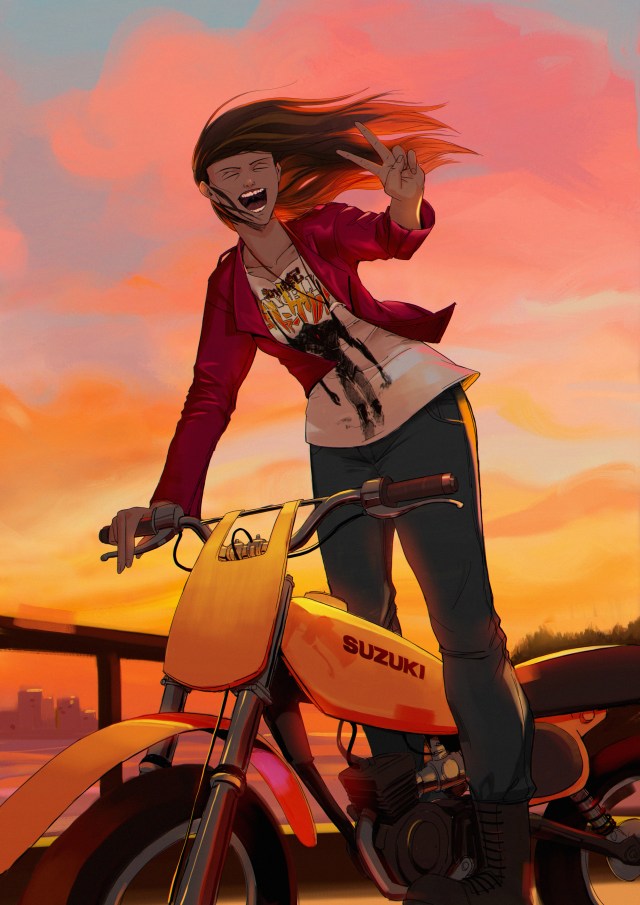
Back in January of this year (2024), I was happily writing away at the last stretch of my hella-long novel We’re Fucked, when, for no discernible reason, I chose to rummage through my rarely-touched drawers and came across an external hard drive. Hoping that it contained albums I hadn’t heard in years, I checked its contents. I discovered the album Sweet Heart Sweet Light by Spiritualized. I had recently used one of their songs for We’re Fucked, and I didn’t recall ever listening to this other album, so I put it on. As the second song, titled “Hey Jane,” played, my subconscious stirred. Vivid images kept bubbling up, far stronger than usual daydreams. One image in particular lodged itself in my brain: a brown-eyed teenage girl leaning on her motorbike’s handlebars at night, smiling warmly at the person who was approaching her. I immediately recognized the strength of this feeling. My subconscious had gifted me such epiphany-level impressions only a few times throughout my life. If I’m lucky, it will do so a few more times in the future. I had been granted a story seed.

The rest of that day, and the following few, were taken over by the obscure workings of my subconscious as it wove together, almost entirely by itself, the tale of this stranger: who she was, why she seemed so comfortable on a bike, who was she smiling at so warmly, etc. I don’t recall how the narrative evolved into one about an aspiring motocross rider with a recklessness streak bordering on tragic flaw. However, it soon became clear that this tale wouldn’t be about love, but grief.

I suppose I have to mention, as I often do, that I’m quite fucked in the head. Was born with so-called high-functioning autism, and either developed after, or got as a side-effect of the abnormal neurological development, some level of OCD that fucks me up with intrusive thoughts, obsessions on top of autism’s own obsessions, and such. Like many on the fringes of typical human behavior, I’m fascinated by outsiders and edge experiences: UFOs, hidden history, weird artifacts, long-extinct animals… Regarding humans, which I rarely care about, I was drawn to the serial-killing kind. While some people, mainly certain types of women, obsess over such monsters and view them as heroes, even attempt to date them, I obsessed over their victims. I wanted to learn everything about who they were before they crossed paths with the man who ended up murdering them. I dreamed about the killings, and imagined myself intervening in those troublesome encounters to save the victims. Even when I didn’t dream about such events, I daydreamed about them. I wrote a couple of stories, of the ones I remember clearly now, of a jaded time-traveler that returned solely to prevent such killings.

With the widespread use of the internet, I came across blogs belonging to relatives of murdered people. One of them that impacted me significantly belonged to the mother of a poor teenager who was killed returning from a concert back in 2008 or so. She got in the car of the wrong person, who raped and murdered her. The mother never got over it (I certainly wouldn’t be able to), and her posts were a window into unending grief, the kind that shoves the person away from the mass of humanity into the fringes.

I know quite a bit about standing in the fringes of humanity. I’m 52% disabled according to the Spanish goverment. During my twenties, that were mainly wasted in long stints as a hikikomori (the pee-in-bottles, befriend-spiders kind), I visited centers for extremely disabled people, and got to interact with the types of human beings you simply do not come across in your daily life: otherwise normal-looking women who were unable to string a sentence together, very intellectually challenged people who casually walked over to groups and ripped loud farts nonchalantly, people so hideous it hurt to look at them, the twitching-and-shouting-insults kinds, the dangerously deluded, some who most weeks presented fresh tales about shitting themselves while “straight-jacketed,” etc. Parents of low-functioning children would often look on with horror at institutionalized low-functioning autistic adults as they were herded around while they twitched and groaned. “It this all I can hope for?” Many human wrecks out there are kept out of view from the public at large lest they disturb the delusion of a just and ordered world.

Whatever neurological configuration drives people to seek out face-to-face interactions has never quite worked for me: human beings in general feel like wild animals, and not the cuddly kind. I’m always wary of people and keep them at arm’s length, partly due to the anxiety I feel in social situations, partly because I lack the innate ability to read their intentions. Over the years, I’ve been tricked and manipulated. I’ve had people tell me, “Why do you keep talking so casually with those individuals? They clearly hate you,” and I didn’t have a clue. In general, people bring more trouble than they’re worth, and my experience with intimate relationships convinced me that such connections lead to mutual pain. Therefore, I’m bound to a life of solitude.

Anyway, what I meant to convey is that my subconscious compelled me to create a tale about someone dealing with unending grief, the kind that isolates him from the rest of humanity. Had I loved someone like Izar Lizarraga, I would have ended up like the narrator, if I hadn’t killed myself to begin with. This is the extent of my justification for why I write what I do. In truth, I simply write to fulfill the demands of my subconscious, hoping to satisfy it. Rational thought plays no part. In fact, I’m extremely suspicious of what’s generally considered intelligence.

I didn’t choose consciously the details of Izar as a character, as well as her relationship with the narrator, but my subconscious was clearly inspired in many cases by my past relationships. The closest in spirit to Izar was a sixteen-year-old basketball player named Leire whom I met online (she was a friend of a dude I used to hang out with), and who later on pursued me romantically. She was reckless, perhaps a bit touched in the head, given that she was interested in a lanky, pimply, clearly deranged teenage me. Anyway, we lay under the stars and had a romantic conversation full of idealism, the details of which I have completely forgotten. Some other day, she invited me to her home, where we made out. We ended up cutting that date short because her parents returned from a trip early.

After that day, I ghosted her. Why would I abandon such a sweet girl without a word? Because right then I understood something: that relationship would end in ruins, like they all would, and liking her as much as I did, like I never had before and never have since, meant that the end of that relationship would obliterate me. Even now, as a thirty-nine-year-old man, I consider that ending it before it truly began was the right choice, given my inability to sustain intimate relationships. However, I regret ghosting her. I regret having lost the opportunity to know her better. Due to my prosopagnosia (an autism-related inability to retain and process people’s faces), I don’t know if I ever saw her again. I can’t even stalk her online, because I forgot her last name. She didn’t deserve to be treated that way. Wherever life took you, Leire, I hope you’re happy.

Fellow autist and writer Patricia Highsmith famously told of a woman she briefly met while working as a toy saleswoman: a sophisticated, mommy-type blond to whom Patricia sold a doll, and with whom Patricia fell in love at first sight. They never saw each other again, but Pat, in her usual manner (she’s the author of Strangers on a Train, The Talented Mr. Ripley series, etc.), proceeded to stalk the woman’s home to get some modicum of understanding of who she was. In later years, Patricia referred to that woman as the love of her life. In a similar sense, Leire is very much the love of my life: the most fascinating girl I have ever met, with whom I would have enjoyed lovely adventures if I weren’t such a piece of rotten shit.

Deeper than that, and I suspect this revelation may disappoint some, Izar Lizarraga of this story’s fame is partly my subconscious itself. Maybe other people can identify with their subconscious as if it were an integrated part of themselves, but for me it’s this mysterious, intelligent being who presents me strange visions, who urges me to work on stuff that pleases her, and to whom I can show some part of a work of art I’m working on, from writing to music, and get a wordless response of the kind “this sucks” or “I love it.”

This subconscious of mine, a creature that feels female, is someone I’d rather interact with instead of any flesh-and-bone person, and who has guided me along in many adventures that I wouldn’t have experienced otherwise. I have never felt truly alone because my subconscious has always been there to bring me interesting dreams (I wouldn’t say beautiful, because plenty of them were horrifying). Back when I thought I could sustain normal human relationships, I regularly ached to return to my subconscious’ side, a more interesting and reliable person than pretty much anybody. I adore you, subconscious. I wish I could make love to you. If you had a butt, I’m sure it would be real nice.

I think that’s all the context I wanted to add to this story. Barely anybody read it, but those of you who followed the tale of Izar Lizarraga and the man she ruined, I hope you got something valuable out of it. And if you didn’t, hey, the one I intended to satisfy is pleased.

Motocross Legend, Love of My Life, Pt. 20 (Poetry)

You can read this novella from the beginning through this link.


On the afternoon of your death anniversary,
Hand in hand with my daughter,
My other hand holding a bouquet of red roses,
We arrived at the spot on the wooded lane
Where a grooved-bark, mature oak
Watched over your memorial stone,
Nestled in moss, twigs, and clover.
Mottled, watery sunlight bathed the stone
As if illuminating a sacred site.

The limestone or sandstone looked rough,
And had weathered over all these years.
Beneath the relief of a motocross rider,
A marble plaque bore the inscription,
“Izar Lizarraga Oyarbide (1981-1999).
She lived fast and died young,
But her light will shine forever.”
My childhood sweetheart,
My restless wildfire.

I crouched in front of the stone
To deposit the bouquet at its base.
I pulled out a pack of wet wipes
And wiped away the dust and grime.
I scrubbed off a white splatter of bird droppings.

The murmur of families filtered through the trees.
A flock of sheep baahed from the nearby hill.
In the stone’s relief, your helmeted figure
Clutched the bike’s handlebars,
Head tilted forward in intense focus.
Every time I laid my eyes on this figure,
My breath caught, my throat clenched,
And I struggled to loosen the knot
Twisted inside my chest.

“How long ago was nineteen ninety-nine?”
My daughter’s innocent voice asked.
After a pause, I said, “A long time ago.”
“Was she a friend of yours?”
“Yes, the best one.”

My daughter shifted her weight from foot to foot
As her attention drifted further down the lane.
I held her little hand tightly in mine,
And we stepped onto the sun-dappled sidewalk.
A familiar warmth built up behind my eyes:
Tears burning their way out.
The vision of a bumblebee weaving its waltz
Across clumps of yellow and white wildflowers
Became a watercolor blur.

Grief had ambushed me once again:
A monstrous hand reaching out of the deep
To grab me by the chest and drag me down.
I know it will remain my constant companion
For the rest of my days.

That week, I pondered why
I had brought my daughter to visit you.
I was terrified that, after my death,
Nobody who came across your name
Or gazed upon the memorial stone
Would understand what had been lost,
What you still mean to me.
I needed my child to be haunted by you,
To carry your spirit in her heart,
But I feared no amount of talk
Could transmit the depths of pain and love.
So, the memories of you would disappear,
Forgotten even by the spiders
That had built their webs within me.

One day, maybe not long from now,
After the kids we dragged into this world
Have freed themselves from their miserable parents
And claimed a home of their own,
I will lie in my deathbed alone,
Connected to beeping machines.
By then, you will feel like a sunken ship
Deep at the bottom of the sea.
Suddenly, I will breathe in a pungent odor of rust,
And from the center of my consciousness,
A sinkhole will open, a growing black hole.
As the edges of my self crumble and collapse,
Into that darkness, I will reach for your hand.

I doubt the value of words:
Pictures and music capture emotions better.
Yet, this old boy can only play with words,
And I’ve engaged in the game of pretending
That they can bridge the chasms between us.

For decades, a barbed pain has grown its tendrils
From the core of my heart throughout my body,
Creeping into every tissue and organ,
Embedding hooks deep in my bones,
As the pain reached the farthest ends of me.
My wish: that the right combination of words
Could sever a scion of this piercing truth
And graft it onto someone else’s heart.

So thank you, stranger,
For reading thousands of words
Of the only tale I care to tell,
My elegy for Izar Lizarraga,
Motocross legend,
Love of my life,
Who blazed through this world,
And burned away.

* * *

The night of April 27, 1999,
You parked in front of the candy shop.
Drenched under the torrential barrage,
We clambered off and removed our helmets.
The taste of rain mingled with your saliva
While the Aprilia’s idling engine rattled
Like a hiker hopping from foot to foot,
Eager to move on.

We wished each other good night.
Thunder growled as you straddled
Your gleaming yellow-and-white bike.
You pulled on your helmet,
Gripped the handlebars,
And lifted the side stand with a kick,
When I shouted, burning my throat,
“Wait!”

Startled, you straightened up,
One foot planted on the sidewalk,
And turned the reflective visor toward me.
I ran to you and hugged you,
Pressing my cheek against the cold helmet.
“You don’t intend to return home, do you?
Who would be so stupid to believe
That you’d go back to your father so soon?
I can’t let you leave, Izar;
If I do, I’ll regret it for the rest of my life.
Stay with me tonight.”

I held your gloved hand
As you stumbled off the Aprilia.
You lifted the visor of your helmet,
Revealing large chocolate eyes
That reflected a shimmer of amber light.
Your brows were furrowed in concern.
From one nostril hung a bead of watery mucus.
“I’d much rather do that,” you said,
“But your mother forbade me from coming back.”
“I’ve taken enough shit from her.
She can suck it up.”
You shook with silent laughter.

I opened the front door to the sight of my parents.
My mother scowled, deepening the lines of her face.
Beside the woman, two steps back, stood my father,
A bald, stooped, hesitant non-entity.

Upon noticing Izar, my mother’s eyes widened.
She opened her mouth to scold me,
But I cut her off.
“Look at what her father has done.”
I brushed away the damp strands of caramel hair
Clinging to the cheek that sported a bruise,
The mottled imprint of your father’s hand.
“Izar can’t go home tonight. It’s not safe.
She’ll stay with me, no matter what you say.”

A glance at the bruise loosened my mother’s brow.
You bowed your head.
“Sorry for bothering you.
I didn’t intend to cause trouble.”
My mother narrowed her eyes.
“You rode here through this downpour?
Girl, you don’t have any common sense!”
“Sorry.”
She tsked, then threw her hands up.
“You pair of idiots. Go take a warm shower.
No, take off your jackets and shoes first.
You’re going to leave puddles all over the house.
My goodness, look at how soaked you are!
Do you want to catch pneumonia?”

As you and I padded hand in hand to the bathroom,
My mother turned to my father, seeking support,
But he shrugged and said,
“Let them be. They’re in love.”

Locked inside the bathroom,
We peeled each other’s soaked clothes,
Then chucked them on the ceramic tiles,
Where they lay like beached jellyfish.

When you untied your ponytail,
The cascading hair stuck to your shoulders.
You rubbed your pruney fingertips.
“We might get sick for real,” you said,
Then sniffled some leaking mucus back in.

I embraced you firmly,
Pressing your stiff nipples against my chest.
You shuddered once, then continued to tremble.
I whispered in your ear,
“My love, in case you have any doubts,
I’ll run away with you.”
You sighed, your breath warm on my neck,
And slid your hands down my back.
“Thank you.”

As we melted into each other,
I caressed the contours of your skin,
The myriad details unique to you
That before you were born,
Hadn’t existed in the universe,
And after you died, never would again.

Yes, Izar, I would accompany you,
Riding pillion, clinging to your waist,
Through the rush of wind and rain,
To witness the sights you longed to see,
To experience what it meant to live.
We would create a shared language,
Speak words that others would find insane,
And build our own space far away.
Nobody could compete with you,
The sole real person in the world.
As long as you were with me,
I was home.

THE END


Author’s note: the last song is “Just Like Heaven” by The Cure.

Motocross Legend, Love of My Life, Pt. 19 (Poetry)

You can read this novella from the beginning through this link.


The eve of your death anniversary
Resurrected the old nightmare once more:
I was riding pillion, clinging to your waist,
While your Aprilia Red Rose growled
As it devoured the highway under its tires.
The rainfall hammering upon car roofs,
Drumming on our helmets,
Splashing against our drenched clothes,
Overwhelmed the steady roar of the engines.
The wind drove icy raindrops into my face.

The beam of your bike’s headlamp
Sliced through the rain sheets,
Lighting the rear wheels of the truck in front,
That spat up trails of rainwater.
In the oncoming lane, twin beams appeared
And quickly expanded toward us,
Cutting luminous swaths across the blackness.
On my right, traffic signs, trees, buildings,
They all blurred into smudges,
And the sparse streetlamps revealed themselves
Like floating, shimmering haloes.

Lights glinted off the gleaming, mirrorlike tarmac
In ripples of red and blue-tinged white.
Above, lightning leaped from cloud to cloud,
Followed by grumbling thunderclaps.

In my embrace, your body trembled;
You were crying, or at least on the verge,
And you channeled that anguish
Igniting your steel beast’s roar
With a wrench of the throttle.
My heart thrummed with dread.
The acceleration pressed against my bones,
Tightening my chest and freezing my breath.
Along with the golden tracers of streetlamps,
Oncoming vehicles whooshed past us.

Lighting the way ahead, we were falling headlong,
Whipping through the darkness like an arrow.
Teary-eyed from the sting of rain,
I raised my voice over the rushing wind,
Over the rumbling engines.
I shouted, I yelled, I gripped your sides tighter,
Imploring you to slow down.
As if you couldn’t hear me, as if I wasn’t there,
You revved the throttle further,
Making the speedometer needle climb sharply.
Your bike’s chassis shuddered under the strain.
The raindrops felt like dozens of fingers
Poking my numb face to wake me up,
But you kept racing through the storm,
Maybe wishing to outrun yourself,
Outrun all the voices telling you to stop.

As we approached a curve, your Aprilia wobbled,
Its front wheel skidded on the rain-slick tarmac,
And the bike lurched sideways,
Flinging us off.

The color spectrum gleaming through the downpour
From headlights, tail lights, streetlamps, and lightning
Spun into a blur of light and dark
While my body flailed, limbs striking out,
Scraping against the road as I slid
With rainwater gushing over me.
The friction ripped through my clothing,
Seared my skin, and tore the flesh off my bones.
Screams lodged in my throat.

Your Aprilia Red Rose was flipping end-over-end,
Scattering pieces of its decimated bodywork.
My frantic gaze glimpsed flashes,
Illuminated by the headlights of passing cars,
Of your body cartwheeling uncontrollably.

A murky shape, the guardrail,
Rushed out of the rain-haze toward us
Like a reef thrusting from a savage ocean.
You smashed against the metal barrier,
Which launched you into the darkness.
I clenched my eyes shut, bracing for impact,
And awaited the final, wet crunch.
When I slammed into that guardrail,
A loud snap reverberated through my spine
In a starburst of pain.

The impact had squeezed my lungs,
Knocking the air out.
As I gasped, mouth agape,
A thunderous crash against the guardrail
Sent a shockwave through the cold steel,
Making me, slumped against it, shudder violently.
Fragments of the bike ricocheted off the barrier
And stung my arms and face like shrapnel.
The metallic clang lingered as a discordant ringing.

Your Aprilia lay on its side close by,
Gleaming darkly in muddy rainwater,
Its windscreen shattered,
Frame bent, chassis mangled,
Front wheel still spinning.
A rearview mirror dangled from its stem,
And reflected the electric clouds.
Fuel leaked out of the dented tank.
The headlamp’s white beam,
Shining through the cracks in the lens,
Faltered, flickered, then faded away.

The ozone scent of the storm mingled
With the chemical smell of gasoline,
The burnt stench of grinding metal,
And the bitterness on my tongue.
A tingling white noise had spread
To the farthest reaches of my body,
And in the places that hadn’t gone numb,
My shredded flesh screamed
In a fiery, knifelike pain.

Instead of writhing in the gutter
Like a crushed insect,
I would return to your side,
But when I tried to stand,
My limp legs refused to move.
I grabbed the cold, wet guardrail,
Then heaved myself over it.
I hit the grassy, upward slope chest-first,
And mud splattered on my face.

I crawled onward, clawing at the grass and soil,
Coating my hands with squelchy mud.
The relentless pounding of heavy rain
Along with the deep rumble of distant thunder
Isolated me in a cocoon of noise.
Every creep up the slope ripped me open with hurt.
In jagged gasps, I breathed razors.
Where are you, Izar? Where are you?

The blades of grass glistened
With a fresh spray of blood.
Silvery light from turning headlights
Swam in waves over a body splayed face up
Like a doll tossed in a tantrum.
Your drenched, ripped red jacket gleamed.
Gashes oozed through the torn jeans.
The crushed helmet still clung to your head.

Beside you, I pushed myself up onto my knees,
And lifted the cracked visor of your helmet.
Raindrops splattered in concentric circles
On the blood pooling within the face aperture.

I attempted to take your helmet off,
But your neck strained, its muscles taut,
As if your head might snap off.
You couldn’t breathe.
“Stay with me, Izar. Don’t leave me, please.”
When I scooped blood out of the hole,
My fingers didn’t graze your face.
I sank my hand up to my wrist, to the elbow,
But I couldn’t reach you.

I woke up with a start, drenched in sweat,
Gasping for breath, clutching at my throat.

My fingers are calloused
From decades of clawing
At the dark soil of this world
To drag myself back to you.


Author’s note: the song for today is “I Lost You” by The Walkmen.

The next part will conclude this story.

Motocross Legend, Love of My Life, Pt. 18 (Poetry)

You can read this novella from the beginning through this link.


I used to know every contour of your face,
The exact timbre of your voice,
The way your body pressed against mine,
Your taste, the salty scent of your sweat.
But your traces are flaking off my brain;
In the seams and margins of my memories,
Bugs and patches have appeared,
Corroding the integrity of a past
That I’m editing, shaping with bias,
As I revisit it time and time again.
Your gaze, your smile, your laughter,
They all fade away into oblivion
With each ticking second.

Izar, I beg you, stay with me.
Let’s leave this suffocating city
On a motocross odyssey spanning Europe:
Hundreds of kilometers of highways,
Speeding through the countryside
Past petrol stations, fields, and farmhouses.
We’ll make love on the shores of the sea,
Then sleep under a blanket of stars.
Let’s rent bikes and ride along the Seine.
Let’s explore the winding streets of Venice,
Swim in the turquoise waters of the Caribbean,
Surf the waves of Hawaii or Costa Rica,
Climb the ancient terraces of Machu Picchu.
For the rest of my days, I will care for you,
Your unstable mind, your fits of rage.

Forgive me these postcard destinations;
You dreamed in exact places: Ponts, Jerez,
A rundown cottage in Sierra Nevada.
I dream in the smudged colors
Of a map left out in the rain.

Growing up, I feared venturing far
From my neighborhood, from my parents.
I dreaded exposing myself to risky experiences.
In my mind, I saw my mother’s stern face,
Ready to scold and ground me
For daring to struggle against the vines
She had wrapped tight around me.
Roam the breadth of Spain? Travel the world?
Such adventures felt as distant as the stars.
I was convinced that even as an adult,
I wouldn’t organize something so troublesome.

But that year, I stood in the blazing Roman heat
With my teenage son beside me
And my daughter’s small hand grasped in mine,
Gazing up at the façade of the Pantheon,
Its towering Corinthian columns glowing faintly,
Burned by the merciless July sun;
Its triangular pediment pockmarked, scarred,
By twenty centuries of plunder and weather.
I longed to appreciate its grandeur in solitude,
But a throng of tourists choked the square.
A listless guy stood dressed like a centurion,
His helmet adorned with a plume of dyed horsehair.
The muscle cuirass concealed the flab
Of a modern man suited to a desk job.

The Pantheon didn’t belong in this post-apocalypse,
Among the disoriented survivors of the 21st century,
Who lacked the knowledge to recreate
The sunlit glory of their once eternal past,
And who had lost the will to rediscover it.

Well, what did you think about the sights, Izar?
We never had the chance to escape together,
But I carried your memory to Rome.
I hope you enjoyed the trip.

In my little corner of the world, whenever I could,
I escaped to the freedom of an isolated bench
Along the wooded lane containing your memorial stone.
There, beneath the sunlight filtering through branches,
Hunched over a notebook, I poured my memories of us,
Capturing in words every detail I could remember.
I discovered that writing tricked the brain
Into gilding moments and affixing them to its cells,
Regardless of their authenticity.

Drawing, writing, they couldn’t save me;
They just helped me endure this lonesome life
For yet another day.
But maybe the right words could save
What remained of you.

In my heart, a secret garden bloomed.
Pollen sparkled on iridescent flowers,
Their petals fanning out like peacock feathers.
In this floral realm where time stood still
And death could never enter,
You, enshrined within a poem or story
That wouldn’t fade, rot, nor be reduced to ashes,
Could live eternally.


Author’s note: the songs for today are “This Is the One” by The Stone Roses, and “Sit Down” by James.

Motocross Legend, Love of My Life, Pt. 17 (Poetry)

You can read this novella from the beginning through this link.


Do you remember, Izar,
That one time in the basketball court
Of our old primary school?
Your hair looked like honey.
Pale wisps floated about your face.
You glanced up at the sky and said,
“The sun’s right above. Look!”
While shielding your eyes with one hand,
With the other, you gestured toward the hoop,
And the round, golden sun,
Glowing with midday heat,
Swished through the net.
You grinned triumphantly at the perfect shot,
The work of a godly markswoman.

In my memories, in my dreams,
Our teenage selves, wild and free,
Dressed in the sun of summer,
Roamed iridescent streets together
Under a sky layered like an oil painting.

One day, after a shower,
I wiped the fog off the mirror
To reveal a man’s naked body
Glimmering through the vapor.
The once lean-muscled figure,
Sculpted laboriously in the gym,
Had softened under the looser skin
To a layer of resigned flesh
That gravity insisted on dragging downward.
With both hands, I grasped my gut,
Stretching it as if to rip it open
And let the aging machinery spill out.

I locked a tortured gaze with the mirror,
With that cold-eyed stranger
Whose wrinkles carved on his face
Deepened each passing year.
His hair and stubble were flecked with gray.
The flaws I scarcely noticed during the day
Beamed back as if lit by headlights.
Every trace of my youth had eroded away;
I had transformed into a middle-aged man
That you, forever eighteen,
Would hardly recognize.

A rapping on the front door shattered the static haze.
When I opened the door, I faced an apparition.
Your chocolate eyes glowed with affection,
Your smile showed off your crooked teeth.
Rainwater slid down your sleek red jacket,
That framed the Evangelion T-shirt underneath.

You had finally returned from the beyond
To replace my dust with your stardust.
I hugged you tight, lifting you off the floor,
And you wrapped your legs around me
While giggling like a girl in love.
“How long has it been?” you asked.
“Far too long.”
“Will you come with me?”

In the corner of the street gleamed
Your beloved Aprilia Red Rose,
Its fuel tank painted yellow-and-white.
High-rise chrome handlebars,
A padded leather seat with visible studs.
Exposed engine components turned the Aprilia
Into a rugged and warworn mechanical beast,
Ready to race through the landscape
With its raw wounds laid to the wind.

As I rode pillion on your bike,
Its throaty rumbling vibrated through the seat.
I rested a hand on the thigh of your jeans,
And felt the firmness of the flesh beneath.

You swerved onto Navarra Avenue toward the highway.
The road ahead lay empty, an invitation to speed.
We passed by an endless procession of ghosts,
Whose whispers blended with the engine’s rumbling.

The low, crimson sun raced toward the horizon,
Stretching wavering, unnatural shadows.
My heart pounded, my breath came in gasps.
Dread clawed at my mind: we might never arrive.
Even as you speeded,
The destination receded farther and farther.
“We’re never going to get there, are we?”
“Where is there?”
“Wherever it is we’re going.”
Your whipping hair framed the profile of your face,
And your lips curled into a sad smile.

Back when you told me you were quitting school
To pursue the goal of becoming a motocross racer,
Should I have convinced you to continue your studies
And to use your spare time to train,
Even at the cost of seeing you less?
That one time in your parents’ apartment,
When your father stomped out of your bedroom
While threatening to go beyond words,
If I, instead of just comforting you,
Had confronted your old man,
Even at the risk of ending up bruised and bloody,
Maybe I would have intimidated him enough
That he wouldn’t have marked you
With a red handprint on your cheek.
If I had instilled in you the fear
That you might ruin both our lives
By crashing during one of your reckless stunts,
Maybe you wouldn’t have died so young.

I see you back on April 27, 1999,
When you scratched flakes of paint
Off that basketball pole.
The wind tugged at your ponytail,
And shiny raindrops dripped
From the soaked tips of your hair.
You turned your youthful face to me
And revealed your plan to leave.
For a moment, I panicked;
Would you untether yourself from me?
But you asked me to run away with you,
To drift through Spain on your bike
Like pirates on the open sea.

I said I would follow you anywhere, didn’t I?
When I replay that night in my mind,
Sometimes I see myself answering you,
And other times, I assumed you knew the answer.
Had I answered enthusiastically,
Promising that nothing and no one could stop me
From accompanying you to the ends of the world,
Would you have chosen to speed through the rain?
Did I let you die thinking I had abandoned you?


Author’s note: the song for today is “The Wait” by Built to Spill.